Easypanel.io: A Modern Hosting Panel for Applications and Databases
Deploy apps, databases, and SSL certificates with Easypanel.io. This review covers features, pricing, installation, and how it compares to alternatives like Coolify and Portainer.
 Dragos7 min read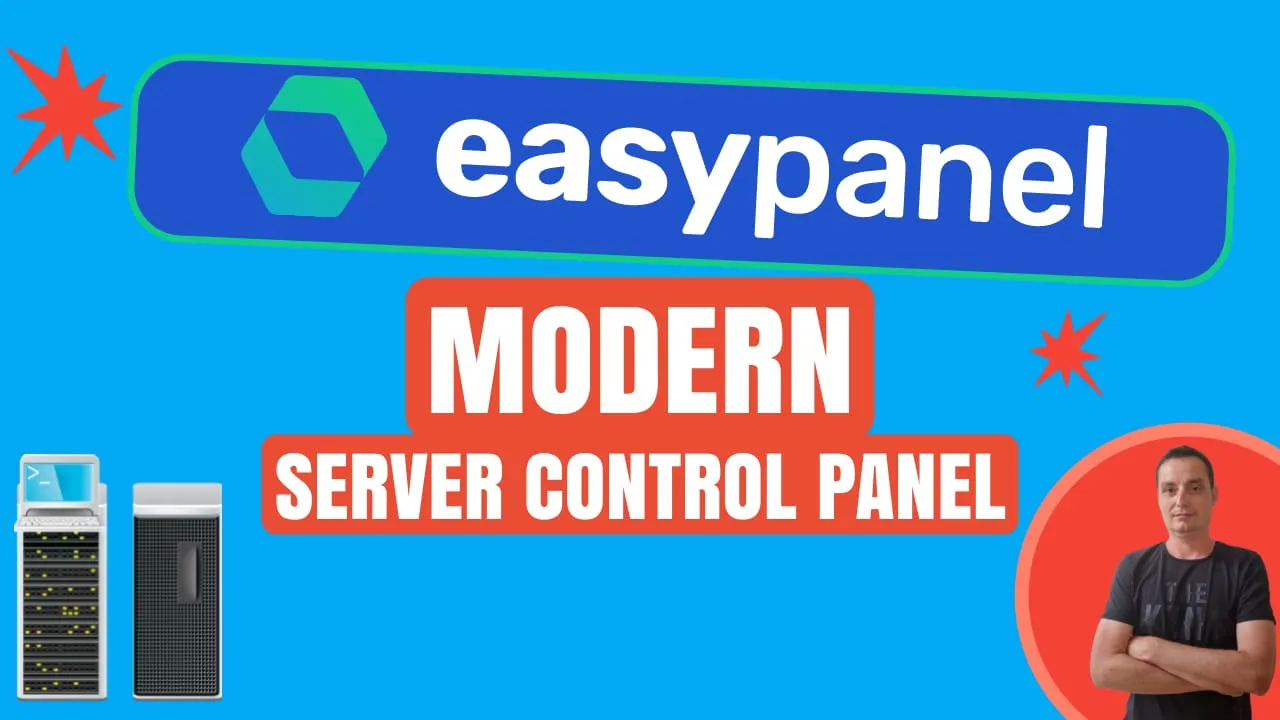
Easypanel.io is a self-hosted server control panel that turns your VPS into a Platform-as-a-Service (PaaS). It uses Docker under the hood but gives you a clean web UI to deploy applications, manage databases, and handle SSL certificates without touching the terminal.
If you’ve used Heroku, Netlify, or Vercel, the workflow feels familiar: push your code, and Easypanel builds and deploys it. The difference is you own the infrastructure and pay only for the VPS.
Other guides you might find useful:
What Easypanel does
Easypanel sits on top of Docker Swarm and Traefik. It handles:
- Application deployment from GitHub repos, Docker images, or Dockerfiles
- Database management for MySQL, MariaDB, PostgreSQL, MongoDB, and Redis
- Automatic SSL via Let’s Encrypt with auto-renewal
- Zero-downtime deployments using Docker Swarm’s rolling update strategy
- Web terminal for running commands inside containers without SSH
- Template library with 200+ one-click installers for popular apps
The panel uses Cloud Native Buildpacks (the same technology behind Heroku) to auto-detect your app’s language and build a Docker image. This means you don’t need a Dockerfile for Node.js, Python, Ruby, PHP, Go, or Java apps.
Pricing
Easypanel has four plans, licensed per server:
| Plan | Price | Projects | Key features |
|---|---|---|---|
| Free | $0/mo | Up to 3 | Unlimited services, unlimited deployments, basic monitoring |
| Hobby | $10.90/mo | Unlimited | Advanced monitoring, notifications, database backups, custom service domains |
| Growth | $16.90/mo | Unlimited | Multiple users, access control |
| Business | $29.90/mo | Unlimited | Cluster support (under development), white-labeling, priority support |
The free plan is genuinely usable for personal projects. Three projects with unlimited services per project covers most homelab and side-project setups. You only need to pay when you want backups, monitoring, or team features.
All paid plans come with a 30-day money-back guarantee. Payments are processed through LemonSqueezy.
What you can deploy
Databases
Easypanel treats databases as first-class citizens. You can spin up any of these with a few clicks:
- MySQL / MariaDB — the standard choice for WordPress, Laravel, and most PHP apps
- PostgreSQL — better for apps that need JSON columns, full-text search, or GIS
- MongoDB — document store for flexible schemas
- Redis — in-memory cache and message broker
Each database gets its own web console, so you can run queries without leaving the browser. You can keep databases private (only accessible from within the server) or expose them publicly.
Templates
The template library has grown significantly. Some popular options:
- WordPress — full CMS with themes and plugins
- Plausible — privacy-focused web analytics
- n8n — workflow automation (Zapier alternative)
- Listmonk — self-hosted newsletter manager
- Grafana — metrics visualization and dashboards
- Uptime Kuma — uptime monitoring with notifications
- Gitea — lightweight Git hosting
- Ghost — publishing platform for newsletters and blogs
Templates are just pre-configured Docker Compose stacks. You can customize environment variables, volumes, and ports after deployment.
Applications
For custom code, you connect a GitHub repository and Easypanel handles the rest. It auto-detects the language, builds the image, and deploys it. Every push to your repo triggers a new build.
Static sites, APIs, full-stack apps — they all work the same way. You can also deploy from a Docker image or a custom Dockerfile if you need more control.
Installation
Here’s how to get Easypanel running on a fresh VPS.
Requirements
- A Linux server (Ubuntu 20.04+ recommended)
- At least 2 GB RAM and 2 CPU cores
- A fresh server with nothing else running on it
Hetzner is a solid choice for the VPS — good performance, low price, and reliable networking.
Hetzner €20 free credit Hostinger VPSStep 1: Update the server
apt update && apt -y upgrade
reboot
Step 2: Add swap (if needed)
Some providers like Hetzner don’t add swap by default. Adjust the size based on your server’s RAM:
sudo fallocate -l 2G /swapfile
sudo chmod 600 /swapfile
sudo mkswap /swapfile
sudo swapon /swapfile
echo '/swapfile none swap sw 0 0' | sudo tee -a /etc/fstab
Step 3: Install Easypanel
One command:
curl -sSL https://get.easypanel.io | shThis script installs Docker (if not present), initializes Docker Swarm, sets up Traefik as a reverse proxy, and deploys the Easypanel container. The whole process takes 2-5 minutes depending on your server’s speed and network.
When it finishes, you’ll see the access URL:
Easypanel was installed successfully on your server!

    http://YOUR_SERVER_IP:3000
The running containers after installation:
docker ps
# CONTAINER ID   IMAGE                          NAMES
# c7295671c7c5   easypanel/error-pages:latest   error-pages
# 1e5a1e16da83   easypanel/easypanel:latest     easypanel
# 71a49438ab9a   traefik:2.8                    traefik
Step 4: Configure the panel
Point a domain to your server. Create an A record in your DNS provider (Cloudflare, Namecheap, etc.) pointing to your server’s IP. A subdomain like panel.yourdomain.com works well.
Set the domain in Easypanel. Open the panel at http://YOUR_SERVER_IP:3000, create your admin account, then go to Settings > General and enter your domain.

Enable 2FA. Go to Settings > Authentication and set up two-factor authentication with an authenticator app. This is important since the panel has full control over your server.
Connect GitHub. If you’re deploying private repos, go to Settings > GitHub and add a personal access token.
Step 5: Deploy your first project
Click Create Project, then add a service. For a GitHub app:

- Select App as the service type
- Connect your GitHub repository
- Choose a build method (Nixpacks for auto-detection, or Dockerfile for custom builds)
- Add your domain under the Domains tab
- Deploy
The free plan allows up to 3 projects, but each project can contain multiple services (app + database + cache, for example).
For more details on deploying specific frameworks, see How to Deploy Astro on Your VPS with EasyPanel.
Easypanel vs alternatives
| Feature | Easypanel | Coolify | Portainer | Dokku |
|---|---|---|---|---|
| Type | PaaS panel | PaaS panel | Container manager | PaaS (CLI) |
| UI | Web-based | Web-based | Web-based | CLI only |
| GitHub auto-deploy | Yes | Yes | No (manual) | Via plugins |
| Database management | Built-in | Built-in | No | Via plugins |
| SSL certificates | Automatic | Automatic | Manual | Via plugins |
| Templates | 200+ | 100+ | Community | Limited |
| Multi-server | Coming soon | Yes | Yes | No |
| Free plan | 3 projects | Unlimited | 5 nodes | Fully free |
| Docker knowledge needed | Minimal | Minimal | Moderate | Moderate |
Easypanel’s strength is simplicity. If you want a Heroku-like experience on your own VPS without learning Docker internals, it’s a good fit. Coolify is similar but has more features (like multi-server support). Portainer is better if you want direct Docker control. Dokku is great if you prefer the command line.
Troubleshooting
Panel not accessible after install. Check that port 3000 is open in your server’s firewall. If you’re using Cloudflare, make sure the DNS record is set to “DNS only” (grey cloud) during setup.
App builds failing. Check the build logs in the Easypanel UI. Common issues: missing environment variables, wrong Node.js version, or insufficient memory. Adding more swap can help with memory-constrained builds.
SSL certificate not provisioning. Make sure your DNS A record is propagated before setting the domain in Easypanel. Let’s Encrypt needs to reach your server to verify ownership.
Container using too much disk. Easypanel doesn’t set Docker log rotation by default. You may want to configure log limits in your server’s Docker daemon settings.
Conclusions
Easypanel is a solid choice if you want to deploy apps and databases on a VPS without becoming a Docker expert. The free plan handles most personal projects, and the paid plans are reasonably priced for what they add.
It’s not the most feature-rich option — Coolify has caught up and offers more for free — but Easypanel’s UI is clean, the setup is straightforward, and the template library covers most common use cases.
For developers who want a self-hosted PaaS that just works, Easypanel is worth trying. Spin up a cheap Hetzner VPS, run the install command, and you’ll have a working deployment platform in under 10 minutes.
Hetzner €20 free credit Hostinger VPS