
ARM vs x86 VPS Benchmarks: WordPress Performance & Cost
ARM vs x86 VPS benchmarks for WordPress in 2026: real YABS and WP test results, updated Hetzner prices, and which server type wins on performance and cost.
Updated Published 15 min read

Disclosure: this guide contains referral links. If you buy through them, I may earn a commission at no extra cost to you.
ARM vs x86 VPS benchmarks for WordPress on Hetzner, with 2026 pricing: I tested matched 4 vCPU / 8 GB boxes on both architectures running WordPress, and the results plus the buy-side math have both shifted since I first published this.
The benchmark numbers below are from test runs in 2025 on Ubuntu 22.04. The performance comparison hasn’t changed meaningfully since. What has changed is the pricing and availability picture on Hetzner, which I’ve updated through November 2026. If you want the Oracle ARM comparison I did earlier, see this Hetzner vs Oracle ARM performance comparison.
Benchmark results are from 2025
The YABS and WordPress benchmark numbers in this article were measured in 2025 on Ubuntu 22.04.3 LTS. The pricing tables, availability status, and cost analysis are current to November 2026. Fresh ARM installs in 2026 should use Ubuntu 24.04 LTS.
What changed since I ran these tests
The performance story barely moved. The buy decision changed completely.
Hetzner announced a price adjustment on 23 Feb 2026 citing DRAM/NAND costs, applied ~33% on April 1, then repriced new orders again on 15 June 2026. The ARM CAX line rose ~30-31% in that final wave, while the x86 CPX line rose 144-175%. Both waves hit existing servers too (April) or new orders and rescales (June). Sources: the April statement and the June standardization statement.
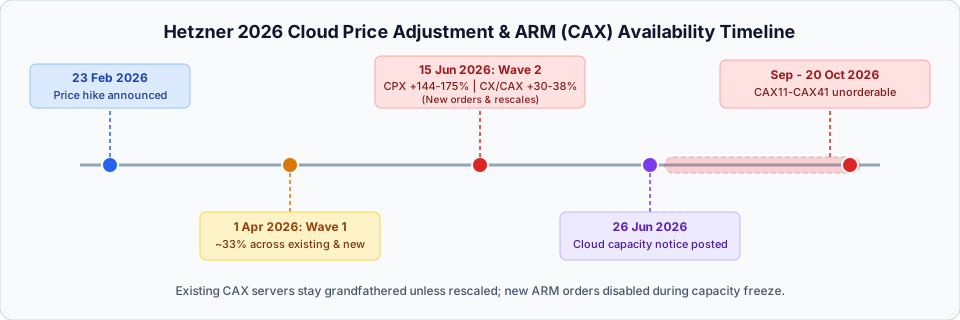
To be clear: the earlier “30-37% across cloud tiers” framing I used was wrong as a general statement. That range only describes the CX and CAX (Cost-Optimized) lines. CPX got hit far harder.
The bigger story for anyone shopping right now: the CAX (ARM) plans are not orderable. Hetzner posted a capacity notice around 26 June 2026. The Create button for CAX11 through CAX41 has been disabled on every check from 2 September through 20 October 2026. Existing CAX servers keep running and are grandfathered at their old prices. For the full picture on which plans exist and what they cost, see the full 2026 Hetzner Cloud price tables (CX, CAX, CPX) and our Hetzner Cloud review after the 2026 price hike.
CAX plans are not orderable (checked 20 Oct 2026)
If you already have a CAX server, keep it. It’s grandfathered at the cheapest compute Hetzner sells right now. If you’re trying to order ARM on Hetzner today, your fallbacks are:
- CX33 (x86 shared, 4 vCPU / 8 GB, €8.49/mo) as a stopgap
- Oracle Cloud A1 free tier (Ampere ARM) to test your stack
- Other ARM providers (Vultr, AWS Graviton) if you need ARM now Re-check the Hetzner Console on the day you order. Capacity comes and goes.
Rescaling can reprice a grandfathered server
If you have a cheap pre-June CAX or CX server, be careful with rescaling. Hetzner’s June 2026 pricing applies to rescales on existing servers, so upgrading a grandfathered box can trigger the new (much higher) rates. Measure twice before you click resize.
One more correction: the tested ARM box in the original article was labeled a CAX31. It’s a CAX21 (4 shared vCPU / 8 GB / 80 GB), as confirmed by the yabs output itself (4 cores, 7.5 GiB RAM, 75 GiB disk) and by FlyWP’s independent testing notes. CAX31 is an 8 vCPU / 16 GB / 160 GB plan. The sibling Hetzner vs Oracle ARM performance comparison has the same label error and is flagged for its own update.
ARM VPS benchmarks: Hetzner CAX21
VPS prices jumped across the board in 2026. If you’re rethinking a rented box, see VPS price increases in 2026 for what changed and when a mini PC wins.
The ARM server is a Hetzner CAX21: 4 shared vCPUs (Ampere Altra, Neoverse-N1), 8 GB RAM, 80 GB NVMe, running Ubuntu 22.04.3 LTS. Tested in 2025. The CAX line uses shared vCPU cores, unlike CPX which gives you dedicated vCPU. That shared model is part of why CAX is cheaper, and it means performance can vary slightly under heavy neighbor load.
Current price (15 June 2026 EU list, excl. VAT): €10.49/month, plus €0.50/mo if you want a dedicated IPv4. That’s up from the original €5.99 launch price, a 75% increase. It’s still the cheapest 4 vCPU / 8 GB option on the platform when it’s orderable.
yabs.sh results
Tested 2025 on Ubuntu 22.04.3 LTS. These are historical results, kept as measured:
Basic System Information:
Processor  : Neoverse-N1
CPU cores  : 4 @ ??? MHz
RAM        : 7.5 GiB
Disk       : 75.0 GiB
Distro     : Ubuntu 22.04.3 LTS
VM Type    : KVM

fio Disk Speed Tests (Mixed R/W 50/50):
Block Size | 4k            (IOPS) | 64k           (IOPS)
Read       | 153.80 MB/s  (38.4k) | 1.11 GB/s    (17.3k)
Write      | 153.69 MB/s  (38.4k) | 1.14 GB/s    (17.9k)
Total      | 307.49 MB/s  (76.8k) | 2.25 GB/s    (35.3k)

Geekbench 6:
Single Core  : 1072
Multi Core   : 3439
Disk IO is fast (4k random at ~153 MB/s is solid for a shared VPS), network is fine, and the Geekbench 6 scores compare well with mid-range x86. To reproduce these numbers on your own box:
curl -sL https://yabs.sh | bashYABS is actively maintained (latest release tagged October 2026) and runs fio, iperf3, and Geekbench 6 in one shot. If you want the full methodology including flags and interpretation, see how to benchmark a cloud server with yabs.sh.
WordPress benchmark results
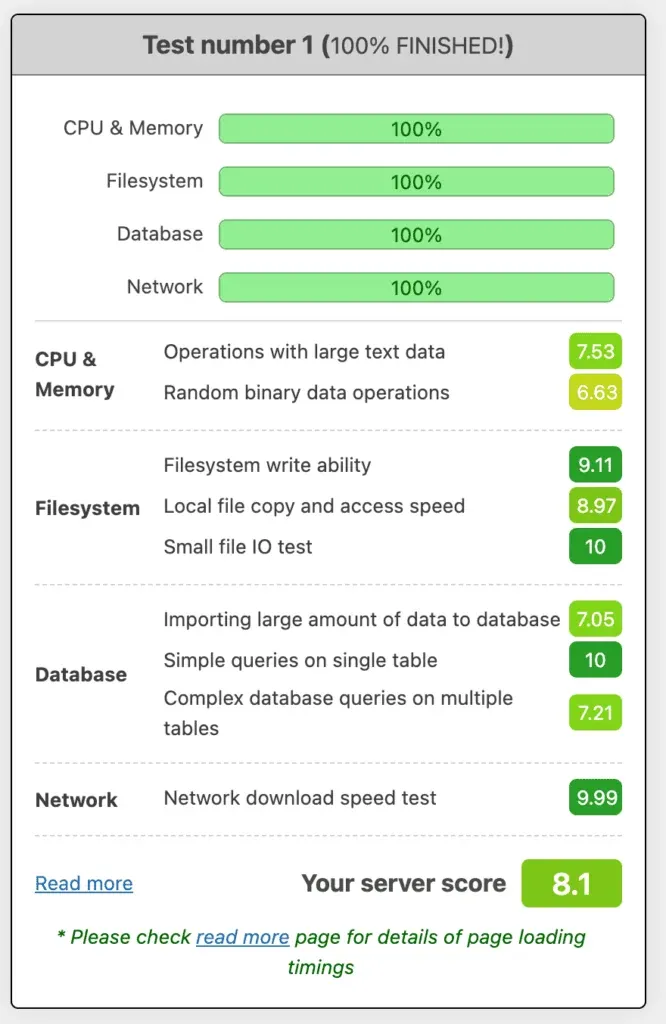
Any score above 8 is good in this WordPress benchmark (it runs a PHP/MySQL workload that approximates what WordPress actually does). The ARM box holds up well. Random binary operations are the weak spot on ARM, everything else is competitive.
If you want to set up the same stack, see how to install WordPress on Ubuntu ARM with CloudPanel.
x86 VPS benchmarks: Hetzner CPX31
Same test conditions: Hetzner, 4 vCPU / 8 GB, same datacenter era, tested 2025. The x86 box is a CPX31 (Gen1) with AMD EPYC Genoa, and unlike CAX, the CPX line gives you dedicated vCPU cores. That means more consistent performance under load, at a higher price.
Note: the CPX31 (Gen1) stopped being orderable on 1 January 2026. Its successor is the CPX32 (4 dedicated vCPU / 8 GB / 160 GB, Gen2) at €35.49/month (15 June 2026 EU list). That’s a 154% increase over what CPX31 cost before the repricing. The x86 dedicated-vCPU line got far more expensive than ARM.
yabs.sh results
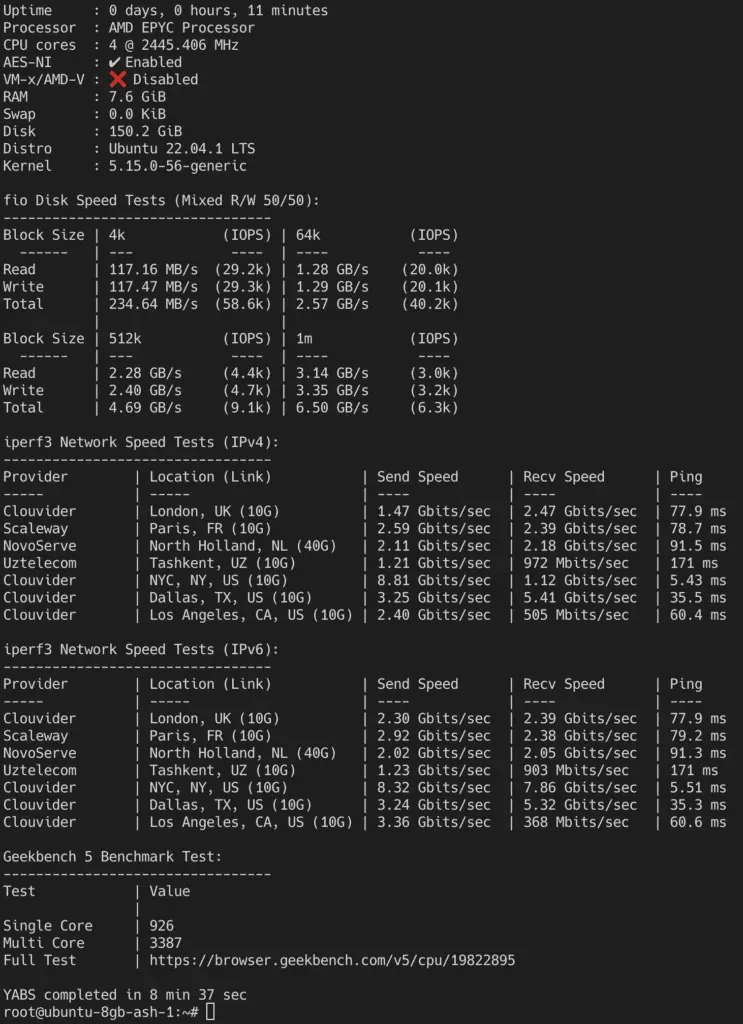
The CPU scores are close to the ARM box. IO and network are similar. You’re not getting dramatically more compute for the extra money, and after the June 2026 repricing, that’s even more true than when I first wrote this.
WordPress benchmark results
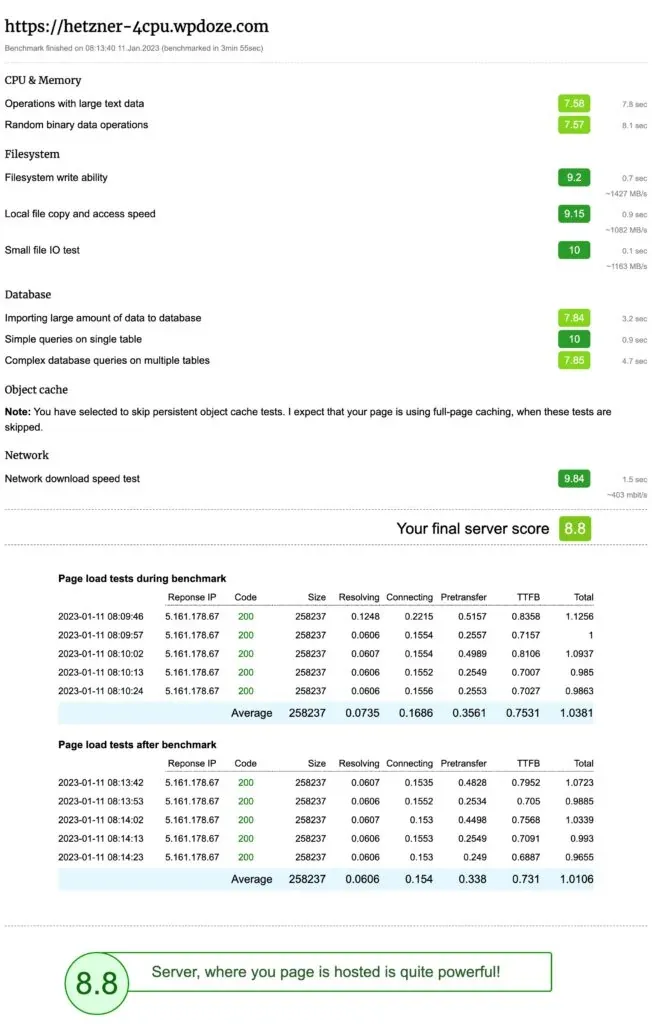
The x86 server scores about 0.7 points higher across the board in the WordPress benchmark.
For a second data point: independent tests from FlyWP (April 2026, CAX21 vs CPX31, WooCommerce in Docker) found ARM ~10% behind on raw CPU, ~7% behind on uncached throughput, and up to ~30% behind on cached RPS, while winning on cost-efficiency by up to 43.5% at the prices they tested. One caveat on their cached numbers: they ran a 30-second warm-up, which puts ARM at its worst case. Behind a real page cache with longer warm-up, that gap shrinks.
ARM vs x86 at June 2026 prices: quick comparison
Below are the numbers at current pricing. I’ve added CX33 (shared x86) as a third column since it’s the pragmatic alternative if CAX stays unorderable.
| CAX21 (ARM) | CPX32 (x86) | CX33 (x86) | |
|---|---|---|---|
| CPU | Ampere Altra, 4 shared vCPU | AMD EPYC Genoa, 4 dedicated vCPU | AMD EPYC, 4 shared vCPU |
| RAM | 8 GB | 8 GB | 8 GB |
| Storage | 80 GB NVMe | 160 GB NVMe | 80 GB NVMe |
| vCPU type | Shared | Dedicated | Shared |
| Price (Jun 2026) | €10.49/mo | €35.49/mo | €8.49/mo |
| Single-thread (GB6) | ~1072 | ~1650 | – |
| WordPress throughput | ~7-10% slower (uncached) | Baseline | – |
| Orderable (20 Oct 2026) | No* | Yes | Yes* |
| Best for | Steady workloads, budget setups | High-traffic, burst-heavy sites | Budget x86 stopgap |
*CAX21 availability blocked on repeated checks through 20 Oct 2026. CX33 showed availability but Hetzner’s Cost-Optimized line has capacity notices from time to time.
Price footnotes
All prices are EU list prices as of 15 June 2026, excluding VAT and excluding IPv4 (adds €0.50/mo on shared plans). Hourly and monthly billing both available (you’re billed whichever is cheaper). 20 TB of EU traffic included. Re-check current prices before ordering.
GB6 single-core for the Genoa box (~1650) comes from the test screenshot. ARM single-thread is meaningfully lower (~1072), which matters for single-request latency. Multi-threaded throughput is closer.
Which is cheaper per RPS? Cost-efficiency math
This is where the 2026 pricing makes the decision easy.
At current prices, CAX21 (ARM) is ~3.4x cheaper than CPX32 (x86) for the same 4 vCPU / 8 GB shape. FlyWP’s benchmark showed ARM delivering about 0.93x the uncached throughput of x86. So:
- ARM RPS per euro:
0.93 / €10.49= 0.0887 RPS/€ - x86 RPS per euro:
1.00 / €35.49= 0.0282 RPS/€ - ARM delivers about 3x the requests per euro.
And it gets better for ARM when you look at the shared-x86 alternative: CX33 at €8.49/mo undercuts CPX32 by ~4x on price for the same 4 vCPU / 8 GB shape. On Hetzner, the dedicated-vCPU x86 line (CPX) has priced itself out of the WordPress conversation. The real 2026 choice is CAX21 if you can order it, or CX33 if you can’t.
If CAX is orderable
CAX21 at €10.49/mo is the best RPS per euro on Hetzner for WordPress. 4 shared vCPU, 8 GB RAM, Ampere Altra. After provisioning, confirm you got an ARM box: run uname -m and expect aarch64. Order here: CAX21 on Hetzner Cloud.
If CAX is NOT orderable
CX33 at €8.49/mo (4 shared x86 vCPU / 8 GB) is the closest match on price and spec. It’s x86, so no ARM compatibility work needed. Alternatively, spin up Oracle Cloud’s free Ampere A1 tier to test your WordPress stack on ARM while you wait for CAX capacity.
Real bills differ from list prices
VAT is excluded from all prices above. IPv4 adds €0.50/mo on shared plans. And if you have a grandfathered pre-June server, rescaling can reprice it at current rates. Factor all three in before comparing monthly costs.
For the complete price tables including all sizes and locations, see the full 2026 Hetzner Cloud price tables (CX, CAX, CPX).
Running WordPress on ARM: compatibility checklist
ARM works for WordPress, but a few things are worth verifying after provisioning:
- Architecture check: run
uname -m, expectaarch64 - PHP extensions: all standard extensions including imagick and webp ship ARM64-native
- Caching stack: Redis, Varnish, and object-cache plugins all work fine on ARM
- Docker images: official images (wordpress, mysql, mariadb, redis) are multi-arch
- Third-party binaries: check any plugin or image that bundles native code (see below)
- OS: use Ubuntu 24.04 LTS for fresh installs in 2026 (the 2025 benchmarks here used 22.04)
Run these after provisioning to confirm your stack is ARM-clean:
# Confirm architecture
uname -m
# Expected: aarch64

# Check Docker image architecture
docker image inspect --format '{{.Os}}/{{.Architecture}}' wordpress:latest
# Expected: linux/arm64

# Check if a binary is ARM-native
file /usr/local/bin/some-plugin-binary
# Expected: aarch64 / ARM aarch64
The main failure mode: third-party WordPress plugins or Docker images that bundle x86-only binaries. You’ll get exec format error when the binary tries to run. Detect it with file ./binary (look for “x86-64” instead of “aarch64”) or docker image inspect --format '{{.Os}}/{{.Architecture}}'. Fix by rebuilding the image with docker buildx build --platform=linux/arm64 (check docker buildx ls first) or dropping the plugin. If you’re running WordPress in Docker, the full WordPress Docker Compose stack guide covers multi-arch images. For bare-metal ARM setup, install Docker and Docker Compose on Ubuntu ARM.
Will my WordPress plugins work on ARM?
Most will. Pure PHP plugins (which is the vast majority) run identically on ARM. The risk is plugins that bundle native binaries or shell out to x86-only tools. Check any performance optimization, backup, or security plugin that installs executables. If it’s pure PHP, you’re fine.
Does ARM hurt WooCommerce?
FlyWP tested a WooCommerce store on ARM and found ~7% lower uncached throughput and up to 30% lower cached RPS versus x86. For a small to mid-size store behind a cache, that’s not noticeable. For a high-traffic store doing heavy uncached cart/checkout operations, x86 dedicated vCPU might be worth the premium.
Do I need to recompile anything?
No. PHP, MySQL/MariaDB, Redis, and Nginx all ship ARM64 packages for Ubuntu. The only time you’d compile from source is if you’re using an obscure extension that doesn’t have an ARM64 .deb. Check with apt list –installed | grep php after setup.
Other ARM VPS providers in 2026
Hetzner’s CAX freeze doesn’t mean ARM is off the table. Your other options:
- Oracle Cloud A1: The always-free tier includes an Ampere A1 instance (4 OCPU, 24 GB RAM). It’s the best free ARM testbed available. Capacity can be flaky in some regions, so don’t bet production on the free tier. I covered this in my Hetzner vs Oracle ARM performance comparison.
- AWS Graviton: Graviton4 is the current generation. Reserved instance pricing can beat Hetzner, but on-demand rates are higher and you’re in the AWS ecosystem with all that implies.
- Vultr: Has Vultr’s ARM cloud compute (Ampere) in select regions. Worth comparing if you need ARM today and Hetzner CAX is blocked.
- GCP Axion / Azure Cobalt 100: Hyperscalers all have ARM chips now. Pricing is enterprise-tier, so these matter more if you’re already in those ecosystems.
If you can’t order ARM and want a budget x86 alternative outside Hetzner, Hostinger VPS offers KVM-based AMD EPYC / NVMe plans at competitive rates.
Note on Hetzner: server types are now per-location (since the September 2025 API change). CX and CAX exist only in EU locations (Nuremberg, Falkenstein, Helsinki). Singapore has CPX Gen2 + CCX; US has CPX Gen1 + CCX. You can check availability per location in the Console or with hcloud server-type list. For a broader comparison of providers, see DigitalOcean vs Vultr vs Hetzner comparison. And if you want the testing methodology, see how to benchmark a cloud server with yabs.sh.
Conclusion: ARM or x86 for your WordPress VPS?
ARM won the price/performance argument. Then Hetzner’s June 2026 repricing made it even more lopsided by more than doubling CPX prices while CAX rose about 30%. The performance gap (7-10% in uncached throughput, more in single-thread) is real but small enough that most WordPress sites behind a cache layer won’t feel it.
The actual obstacle right now is availability. CAX has been unorderable since late June 2026, checked as recently as 20 October. If you have a grandfathered CAX server, keep it and don’t rescale it. That’s the best compute deal on the platform.
For new buyers: test your stack on Oracle’s free A1 tier or any available ARM box while waiting. If you need to buy today on Hetzner, CX33 at €8.49/mo is the pragmatic stopgap. Skip CPX for WordPress at those prices; it only makes sense for workloads that genuinely need dedicated vCPU.
TL;DR
- Performance gap is real but small (~7-10% uncached throughput). Most WordPress sites won’t notice.
- Price gap is huge: ARM is ~3.4x cheaper per spec on Hetzner at June 2026 prices.
- Blocker is availability: CAX is unorderable. Re-check the Console, use CX33 as a stopgap, or test on Oracle free tier.
If you want to speed up WordPress and make the performance gap even less relevant, speed up WordPress with Varnish cache. A proper cache layer is worth more than picking the “faster” CPU.
Try Hetzner Cloud NowRelated Posts



Did this guide work for you?

Written by Dragos
Dragos is the author of Bitdoze — practical DevOps, programming, and self-hosting guides.
More guides from Dragos →Need help with Astro, VPS, or a self-hosted app? View services →