
Hetzner vs Oracle ARM VPS: Benchmarks After the 2026 Cuts
Hetzner vs Oracle ARM VPS benchmark comparison: Geekbench, fio disk, network and WordPress tests, plus 2026 pricing after Oracle cut the free ARM tier.
Updated Published 19 min read
Disclosure: this guide contains referral links. If you buy through them, I may earn a commission at no extra cost to you.
The Hetzner vs Oracle ARM VPS question used to be simple: Oracle’s always-free tier gave you 4 OCPU and 24 GB of RAM on Ampere Altra silicon, and Hetzner charged for a smaller box with better disk. I benchmarked both in February 2026 with Geekbench 6, fio, and a real WordPress install. Since then, Oracle quietly halved the free ARM allotment and Hetzner repriced twice. The RAM comparison flipped sides. Here are the original numbers with the 2026 corrections layered on top.
Both servers run Ampere Altra cores, so CPU scores land close together. Where they diverge is disk, network, and what happens to your bill or your instance when a provider changes the rules. For more background on ARM versus x86 for WordPress workloads, see my ARM vs x86 VPS benchmarks for WordPress.
Try Hetzner Cloud NowWhat changed since publication
- Oracle halved the always-free Ampere A1 tier from 4 OCPU / 24 GB to 2 OCPU / 12 GB around June 10, 2026 (no public announcement).
- Hetzner raised cloud prices on April 1 and again on June 15, 2026. Prices now vary by datacenter location.
- The original article listed the Hetzner CAX31 as 4 vCPU / 8 GB / 80 GB. Those are CAX21 specs. The CAX31 is 8 vCPU / 16 GB / 160 GB NVMe.
Full details below in What Changed in 2026.
What changed in 2026
Two things landed after I published the February 2026 benchmarks. Both change the math.
| Date | Event | Source |
|---|---|---|
| Feb 2026 | Benchmarks in this article measured | This article |
| Apr 1, 2026 | Hetzner price increase #1 (~33% avg, existing customers included) | The Register 2026-02-24; bitdoze analysis |
| ~Jun 10, 2026 | Oracle quietly halves Always Free A1: 4 OCPU / 24 GB to 2 OCPU / 12 GB | Linuxiac 2026-06-14; InfoQ 2026-07-03 |
| Jun 15, 2026 | Hetzner price increase #2 (“up to 200%” per heise; “up to 3x” per Cybernews) | heise 2026-06-15; Cybernews 2026-06-16 |
| Nov 2026 | This update | Now |
Oracle halved the always free Ampere A1 tier
Oracle changed the Always Free documentation between June 3 and June 14, 2026. Wayback snapshots from June 3 still show “3,000 OCPU hours and 18,000 GB hours per month, equivalent to 4 OCPUs and 24 GB of memory.” The live page now says “1,500 OCPU hours and 9,000 GB hours, equivalent to 2 OCPUs and 12 GB.”
No announcement. Just a quiet docs edit, covered by Linuxiac (June 14), heise (June 16), InfoQ (July 3), and news.lavx.hu (July 3).
What this means in practice:
- A pair of 1 OCPU / 6 GB instances fits the new ceiling. A single 4 OCPU / 24 GB instance does not.
- Free-only accounts risk shutdown if A1 usage exceeds the new limits. Pay-as-you-go (PAYG) accounts risk being billed for the overage instead.
- If you terminate an oversized instance, Oracle’s docs warn it “may fail to return above the updated Always Free limit.” Deleting and recreating can cost you the capacity permanently.
- PAYG enforcement is ambiguous. Community reports say Oracle support told PAYG customers the old 4/24 allowance still applies, while the public docs say 1,500/9,000 for all tenancies. I cannot resolve this either way. Check your own tenancy’s limits in the console.
Hetzner repriced cloud servers twice
Hetzner announced increases in late February 2026, citing “drastic” component and RAM costs. The first adjustment hit April 1 and applied to new and existing servers (average ~33%). The second landed June 15 with reported increases “up to 200%” on some plans (heise, Cybernews, The Stack).
Prices are now per-datacenter. The same plan can cost different monthly amounts in Falkenstein, Ashburn, or Singapore. Existing servers were repriced both times. If you budgeted around the old numbers, re-check your invoices.
The April and June increases are part of a broader 2026 VPS pricing reset I covered in VPS price increases in 2026 and when a mini PC wins.
Hetzner ARM (CAX) pricing
Prices changed twice in 2026
Hetzner prices now vary by location and were adjusted again in June 2026. Check the live create-server screen for current numbers. The figures below carry the date they were verified.
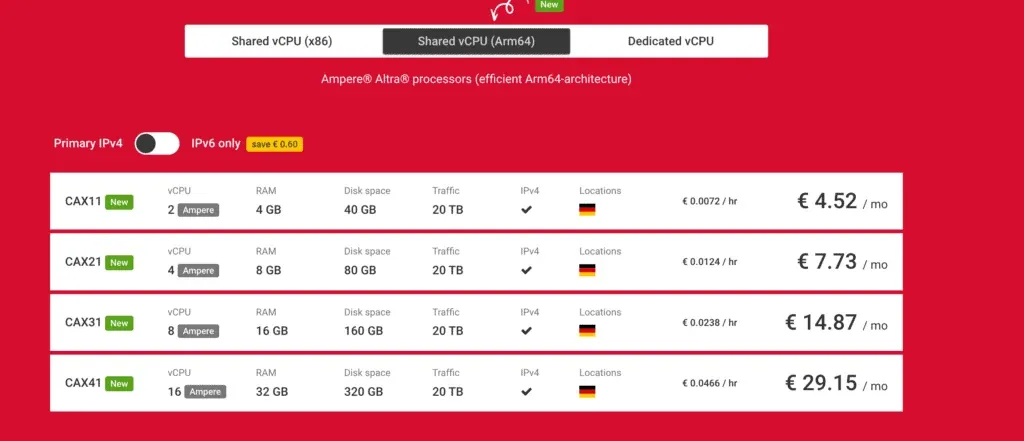
2025 prices. The current create-server screen shows different numbers.
The CAX lineup (corrected specs)
The original article had the CAX31 specs wrong. Per Hetzner Cloud’s own pricing page (Wayback snapshot, June 2025), here is the actual lineup:
| Plan | vCPU | RAM | NVMe | Traffic | 2025 EU price |
|---|---|---|---|---|---|
| CAX11 | 2 (Ampere) | 4 GB | 40 GB | 20 TB | €3.29-3.79 |
| CAX21 | 4 (Ampere) | 8 GB | 80 GB | 20 TB | €5.99-6.49 |
| CAX31 | 8 (Ampere) | 16 GB | 160 GB | 20 TB | €11.99-12.49 |
| CAX41 | 16 (Ampere) | 32 GB | 320 GB | 20 TB | ~€23.99 |
The article’s “4 vCPU, 8 GB RAM, 80 GB NVMe” description was CAX21’s config, not CAX31. The CAX31 has always been 8 vCPU / 16 GB / 160 GB since its 2023 launch. For current cost-optimized options, see my Hetzner Cloud cost-optimized plans breakdown.
2026 price history
The 2025 list prices above are no longer what you pay. The EU timeline (excluding VAT) for the two plans discussed most here:
| Plan | 2025 EU list | Apr 1 ’26 | Jun 15 ’26 (IPv6-only) | Jun 15 ’26 (with IPv4) |
|---|---|---|---|---|
| CAX21 | €5.99 | €7.99 | €10.49 | €10.99 |
| CAX31 | €11.99 | €15.99 | €20.99 | €21.49 |
Community-reported changes on other plans (via r/hetzner and my pricing analysis, September 2026): CAX11 went from €4.49 to €5.99 excl. IPv4 (€6.49 incl. IPv4), CPX22 from €7.99 to €19.49, and CCX23 from €31.49 to €85.99.
Hetzner’s €0.50/month primary IPv4 surcharge is now shown included in headline list prices on hetzner.com (you deduct €0.50/month if you choose IPv6-only, bringing CAX31 from €21.49 down to €20.99).
Also check live stock in the Cloud Console before planning around CAX: Hetzner’s Cost-Optimized tiers (CX and CAX) have had periodic availability limits since late June 2026.
Locations and per-datacenter pricing
Hetzner Cloud now runs in six locations: Germany (FSN1 Falkenstein, NBG1 Nuremberg), Finland (HEL1 Helsinki), USA (ASH1 Ashburn, HIL1 Hillsboro), and Singapore (SIN1). The old “Germany and Finland” claim in the original article is outdated for x86, though ARM (CAX) plans remain EU-only (Falkenstein, Nuremberg, Helsinki) with 20 TB/month of included traffic.
For x86 tiers (CPX and CCX), pricing now varies by datacenter — US and Singapore locations run roughly 15–30% above EU rates and include less traffic. If you are running OCI in Ashburn and want low latency to the same region, Hetzner’s ASH1 location is an option on x86 (CPX/CCX), while ARM (CAX) stays in EU. For a full take on the platform after the price hikes, read my full Hetzner Cloud review.
CAX vs CPX (x86)
The original article compared CAX31 to CPX31 as equivalents. They are not. CPX31 is 4 vCPU / 8 GB / 160 GB (the older US/Gen1 shape). In the EU lineup, the x86 siblings of the CAX31 (8 vCPU / 16 GB / 160 GB) are the Cost-Optimized CX43 (8 vCPU / 16 GB / 160 GB at €15.99–16.49) and the Regular Performance CPX42 (8 vCPU / 16 GB / 320 GB at €69.49–69.99). ARM still undercuts Regular Performance x86 by a wide margin, though CX43 sits slightly cheaper than CAX31 if x86 works for you.
Benchmark results
Benchmark provenance
These numbers were measured in February 2026 on the then-current instances. The Hetzner Geekbench multi-core ratio (~3.1x single-core) is consistent with a 4-core box, not an 8-core one. The plan tested may have been CAX21 and mislabeled as CAX31. The disk and network results are directionally unaffected: Hetzner’s local NVMe beats Oracle’s network-attached volume regardless of which CAX plan it was.
Oracle always free Ampere A1
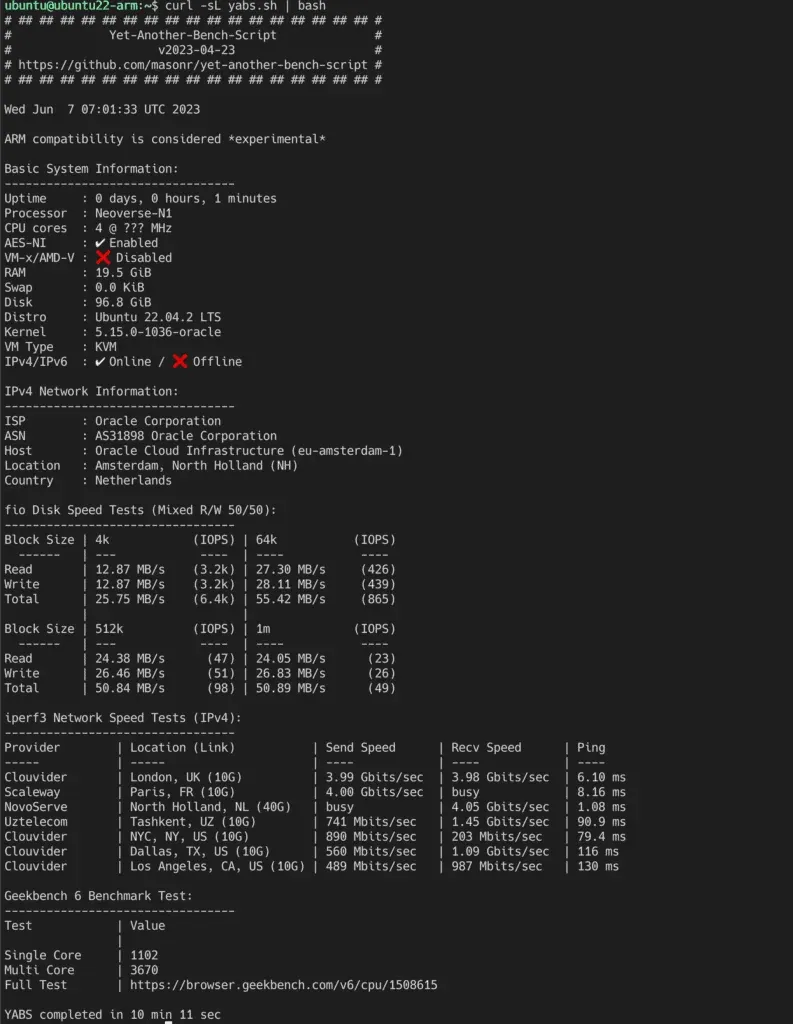
Measured on the then-4 OCPU / 24 GB allotment in February 2026. The free allotment is now 2 OCPU / 12 GB (see What Changed).
Geekbench 6: 1102 single-core, 3670 multi-core. Sequential disk reads around 55 MB/s. Oracle’s boot volume is a network-attached block volume (iSCSI-style, default 10 VPUs/GB performance), which explains the disk number. It is not “shared NFS” as the original article said, but the operational conclusion is the same: slow, network-dependent storage.
The always-free storage envelope is 200 GB combined boot + block volumes, 5 volume backups, minimum boot volume 47-50 GB.
Hetzner CAX (Ampere Altra)
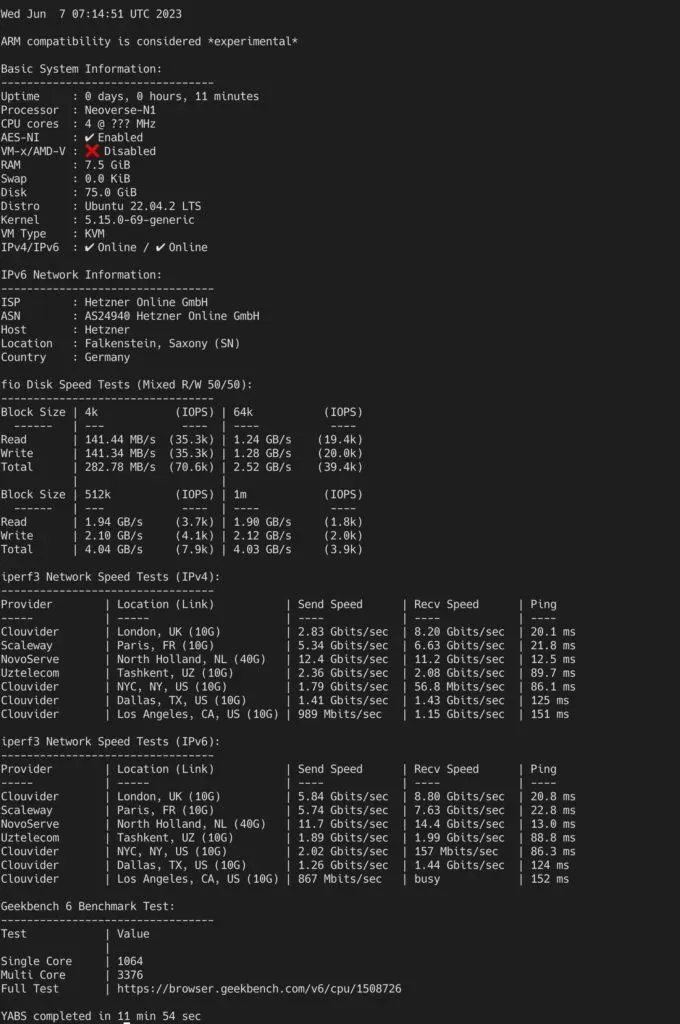
Geekbench 6: 1064 single-core, 3376 multi-core. Disk reads up to 2.5 GB/s on local NVMe. See the provenance note above about which CAX plan this was.
The disk gap is the headline result and it has not changed: local NVMe at 2.5 GB/s versus a network-attached boot volume at 55 MB/s.
What the numbers show
CPU: Geekbench 6
Nearly identical. Oracle scored 1102/3670 and Hetzner scored 1064/3376 (measured Feb 2026). Same Altra cores, similar clocks, shared tenancy on both sides. CPU is not the differentiator here, and it never was. For the broader picture of ARM versus x86 for WordPress, see ARM vs x86 VPS benchmarks for WordPress.
Disk: NVMe vs network-attached boot volume
This is where the comparison gets decisive. Hetzner’s CAX instances use local NVMe storage. Reads hit 2.5 GB/s. Oracle’s free tier runs on network-attached block volumes (iSCSI-style) with default 10 VPUs/GB performance. Reads measured around 55 MB/s.
For databases, WooCommerce, or anything that does frequent small reads and writes, this gap matters more than CPU. A busy WordPress site on 55 MB/s disk will feel slow in ways Geekbench does not capture. Hetzner’s local NVMe makes the same workload feel instant.
Network and latency
Hetzner is faster with lower latency to European endpoints. Oracle’s free-tier bandwidth scales with OCPU count, and at 2 OCPU it gets less network than the 4 OCPU box I tested in February.
One nuance: Oracle’s egress allowance is generous (10 TB/month outbound). The bottleneck is throughput, not a tiny data cap. If you are pushing heavy traffic from Oracle to US users, consider that Hetzner now has US locations (ASH1, HIL1) with different latency profiles.
WordPress on Hetzner ARM
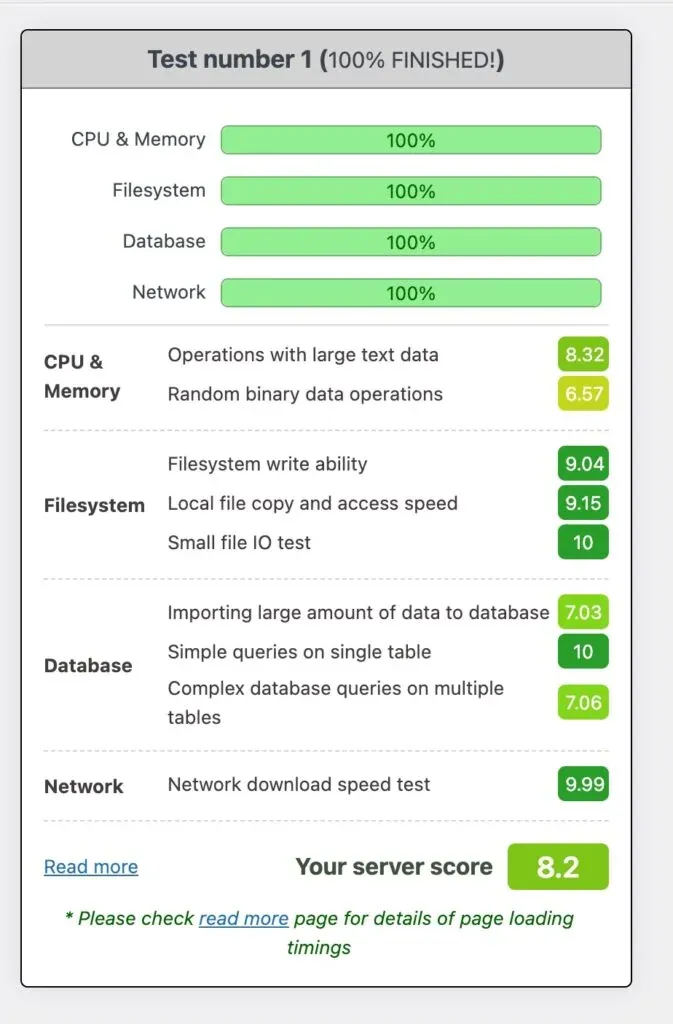
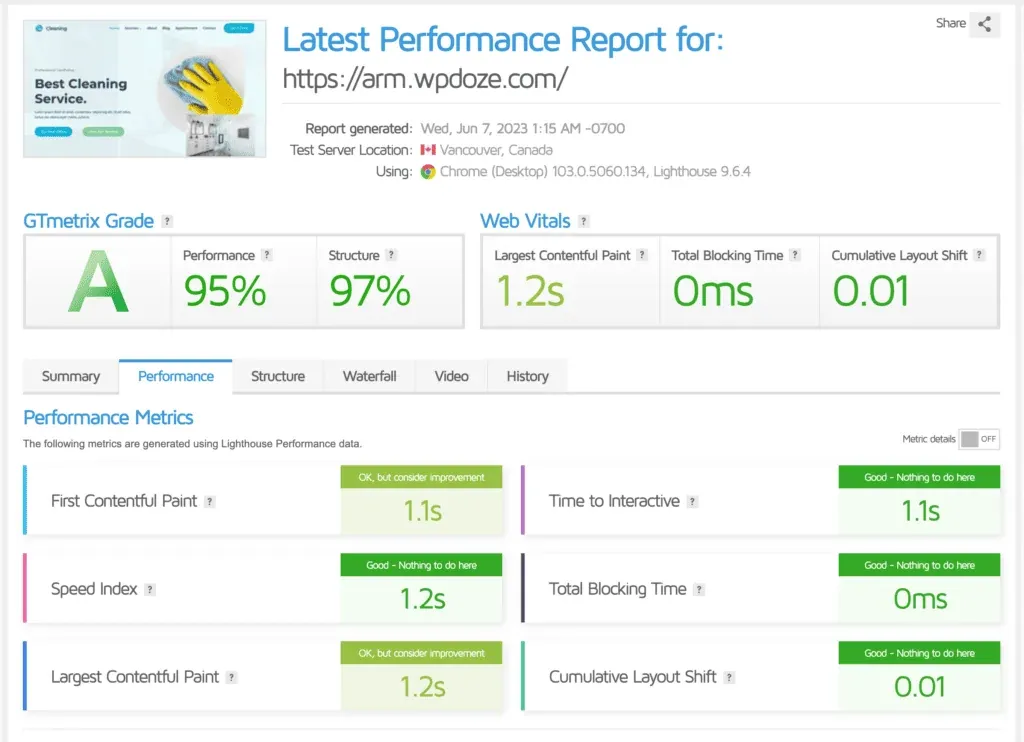
WordPress runs well on ARM. The WordPress benchmark scores are above 8 (the threshold for good performance), and GTMetrix shows fast real-world page loads. I moved several WordPress sites to Hetzner ARM without compatibility issues. The install process is identical to x86: CloudPanel, PHP, MariaDB or MySQL, done.
Now that the free Oracle box shrank to 12 GB and the CAX31 has 16 GB, the Hetzner box has more RAM headroom than the free tier. For real production WordPress, that matters.
- CloudPanel or similar panel for site management
- Nginx or Caddy as reverse proxy
- Backups to S3-compatible storage (off-server)
- CDN for global delivery, a CDN like Bunny.net works well
- Object caching (Redis) for WooCommerce or busy sites
Once you have WordPress running on ARM, you can speed up WordPress with CloudPanel Varnish for another layer of performance.
What to run on an ARM VPS
Most software supports ARM now. These boxes handle the usual self-hosting stack without problems:
- WordPress via CloudPanel (same install process as x86)
- Docker containers built for ARM (Plausible, Uptime Kuma, Grafana, and most popular images ship arm64)
- Node.js applications
- Python apps
- Databases (PostgreSQL, MariaDB, Redis)
The one caveat: check that any third-party agents or proprietary software you depend on has ARM builds. Most popular open source projects do. Some commercial agents (monitoring, security) do not. If you are running Docker on Hetzner, take a look at securing a Hetzner Docker server for the hardening basics.
How I tested (reproduce the benchmarks)
Here are the exact commands behind the screenshots. Run them on your own boxes to compare. Outputs will vary with load, CPU governor, and neighbor noise on shared cores, but the order of magnitude should match.
For a broader methodology, see how to benchmark cloud servers with YABS.
Compare, don't expect byte-identical
These commands were run in February 2026. Shared Altra cores have variable steal time and Geekbench version affects scores. Use them as a baseline, not a pass/fail test.
YABS (all-in-one)
curl -sL https://yabs.sh | bash -s -- -gRuns Geekbench, fio disk tests, and iperf3 network tests in one shot. Output format matches the screenshots above.
Disk (fio)
# Sequential read (the 2.5 GB/s vs 55 MB/s headline)
fio --name=seqread --filename=/tmp/fio.bin --size=1G \
    --rw=read --bs=1M --direct=1 --iodepth=8 \
    --runtime=30 --group_reporting

# Random 4K read (what databases actually do)
fio --name=randread4k --filename=/tmp/fio.bin --size=1G \
    --rw=randread --bs=4k --direct=1 --iodepth=32 \
    --runtime=30 --group_reporting
CPU (Geekbench 6)
# Geekbench 6 for Linux aarch64
# Record the version number you use
./Geekbench-6.3.0-LinuxARMPreview/aarch64/geekbench6 --upload
Note the CPU governor and steal time on shared cores for honest comparison.
Network (iperf3)
# To Hetzner's own speed test endpoint (EU)
iperf3 -c speedtest.fsn.hetzner.com -p 5201 -P 4

# Or the generic Hetzner endpoint
iperf3 -c iperf.hetzner.com
Oracle limits (oci CLI)
# Check YOUR tenancy's actual Always Free ceiling
# (PAYG may show different values than free-only)
oci limits quota list --service-name compute --all
This shows the OCPU and memory quotas your account actually has, which may differ from what the docs say depending on when you created the tenancy.
Quick comparison: Oracle free tier vs Hetzner CAX
| Oracle Free Tier | Hetzner CAX21 | Hetzner CAX31 | |
|---|---|---|---|
| CPU | 2 OCPU (Ampere A1) | 4 vCPU (Ampere) | 8 vCPU (Ampere) |
| RAM | 12 GB | 8 GB | 16 GB |
| Disk | 200 GB network-attached volumes | 80 GB NVMe | 160 GB NVMe |
| Disk read speed | ~55 MB/s | ~2.5 GB/s | ~2.5 GB/s |
| Network | 10 TB/mo egress, throughput scales with OCPU | 20 TB/mo (EU) | 20 TB/mo (EU) |
| Price | $0 | €10.49–10.99/mo (Jun 2026) | €20.99–21.49/mo (Jun 2026) |
| Provisioning | Capacity not guaranteed | Instant (subject to CAX stock) | Instant (subject to CAX stock) |
| Best for | Testing, staging, throwaway | Small production, dev | Production WordPress, databases |
Price cells and stock
Hetzner prices changed twice in 2026: EU CAX21 is €10.49/mo IPv6-only (€10.99 with IPv4) and CAX31 is €20.99/mo IPv6-only (€21.49 with IPv4), excluding VAT, subject to Cost-Optimized stock availability. Verify on the create-server screen before committing. Oracle’s “2 OCPU / 12 GB” is the documented ceiling as of November 2026.
The flip: in February 2026, Oracle gave you 24 GB of RAM and Hetzner gave you 8 GB (if CAX21 was what was tested) or 16 GB (CAX31). Oracle now gives 12 GB and Hetzner CAX31 gives 16 GB. Hetzner wins on RAM, cores, disk, and predictability. Oracle wins on price.
Which to choose
Oracle free-tier failure modes
- Idle reclamation: if 95th-percentile CPU, network, and memory are all below 20% over a 7-day window, Oracle may reclaim the instance.
- Capacity: “Out of host capacity” is the official error when creating free-tier shapes. Try another availability domain, wait, or upgrade to PAYG.
- Terminate-and-recreate: oversized instances may not come back after deletion under the new limits.
- Port 25 blocked: outbound email is blocked by default. Requires a service-limit request.
- No SLA: free tier has no uptime guarantee.
When free still wins. The Oracle free tier at 2 OCPU / 12 GB is fine for staging environments, low-traffic projects, learning, CI runners, and anything where you can tolerate losing the instance. If you need OCI object storage for backups alongside it, you can upload files to an Oracle Cloud (OCI) bucket with a short Python script. Free is free.
When Hetzner wins. For production WordPress, databases, WooCommerce, or anything disk-bound, Hetzner CAX is the clear choice. You get 8 cores, 16 GB RAM, local NVMe at 2.5 GB/s, and instant provisioning. No capacity lottery, no idle-reclamation timer, no slow disk. The DigitalOcean vs Vultr vs Hetzner comparison covers other paid options if you want to shop around; DigitalOcean and Vultr both sell ARM instances too.
Once you pick Hetzner for production, secure a VPS with CrowdSec and lock down the basics before you put real traffic on it.
Cost-risk and the exit ramp. Hetzner repriced running servers twice in three months. Budget for that. At €20.99–21.49/month after the June 2026 adjustment, CAX31 is still cheap for 8 cores / 16 GB NVMe, but it is not the €11.99 you might have seen in old blog posts. This is the risk you take with any rented box; the VPS price increases in 2026 and when a mini PC wins analysis covers the broader trend. If re-pricing is a dealbreaker long-term, mini PCs for a home server are a real exit ramp. A GMKtec M6 Ultra mini PC at ~$500-700 pays for itself in 2-3 years versus a mid-tier VPS and gives you full control.
Try Hetzner Cloud NowFAQ
Is Oracle's free ARM tier still 4 OCPU / 24 GB?
No. Oracle cut the Always Free Ampere A1 allotment to 2 OCPU / 12 GB (1,500 OCPU-hours + 9,000 GB-hours per month) around June 10, 2026. The change was made quietly in the documentation. Wayback snapshots from June 3, 2026 still show the old 4/24 numbers. See Oracle’s Always Free Resources page for current details. There is an unresolved question about whether PAYG tenancies are held to different limits than free-only accounts; the docs say one thing, community reports of support replies say another.
Will my existing 4 OCPU / 24 GB instance keep running?
Unverified. Community reports are conflicting. Some users report their existing instances continuing to run at the old specs; others report being forced down. If you have a pre-June 2026 instance, check your tenancy’s actual limits in the OCI console. Do not terminate and recreate an oversized instance under the new rules, as Oracle’s docs warn it may not be possible to provision it again.
How do I avoid Oracle idle reclamation?
Oracle deems an instance idle if, over a 7-day window, the 95th-percentile CPU, network, and memory utilization are all below 20% (memory rule applies to A1 shapes). To stay above the threshold, keep sustained load on the box: run real workloads, health checks, or scheduled jobs. If your workload is genuinely idle, move it to a provider that does not reclaim. This is an official policy, not a rumor.
Why did Hetzner's prices change twice in 2026?
Hetzner cited “drastic” component and RAM costs (the so-called “RAMpocalypse” from AI demand). The first increase took effect April 1, 2026 (~33% average, applied to existing servers). A second adjustment landed June 15, 2026 with some plans reportedly going up 200-300%. Prices now vary by datacenter location. This is why I treat price-increase risk as a first-class factor when recommending where to run production.
Was the benchmark run on a CAX31?
I am not 100% certain. The Geekbench multi-core score (3376 vs 1064 single-core, a ~3.1x ratio) is what a 4-core Altra box scores, not an 8-core one. The benchmarks may have been run on a CAX21 and mislabeled as CAX31. The disk and network results (the headline claims) are unaffected by which CAX plan it was: local NVMe is fast on all of them. If you need certainty, re-run the commands in How I Tested on a known plan.
Verdict
CPU parity between Oracle ARM and Hetzner ARM is a property of the silicon and that has not changed. What changed is the deal around the hardware. Oracle’s free box halved to 2 OCPU / 12 GB with reclamation risk and slow disk. Hetzner’s CAX31 is 8 cores / 16 GB NVMe at €20.99–21.49/month (when Cost-Optimized stock is open), with the caveat that Hetzner has shown it will reprice running servers when component costs move.
For production WordPress, databases, or anything disk-bound: Hetzner CAX wins and it is not close. For throwaway work, staging, or learning where you can tolerate losing the instance: Oracle’s free tier is still worth using. Just go in with your eyes open about the strings attached.
Related Posts


Did this guide work for you?

Written by Dragos
Dragos is the author of Bitdoze — practical DevOps, programming, and self-hosting guides.
More guides from Dragos →Need help with Astro, VPS, or a self-hosted app? View services →