Fish Audio vs ElevenLabs 2026: I Switched and Saved $84/Year
Six months on ElevenLabs, then Fish Audio. Side-by-side on English quality, cloning (15s vs 60s), 83 languages, emotion tags, and real monthly cost.

Updated Published 8 min read
I used ElevenLabs for about six months before switching to Fish Audio. Not because ElevenLabs is bad. It is not. Multilingual support was not enough for my English/Romanian mix, and the bill was getting silly for a solo creator. After running both on the same scripts, here is what actually differed.
The short version
Fish Audio wins on multilingual content, emotion tags, cloning speed, and price. ElevenLabs still wins raw English fidelity and has a cleaner UI. If you only ship English and quality is everything, stay on ElevenLabs. Everyone else should try Fish first.
| Feature | Fish Audio | ElevenLabs |
|---|---|---|
| Voice cloning audio needed | 10-15 seconds | 60+ seconds |
| Cheapest plan with cloning | Free / $15/mo | $22/mo |
| Languages | 83 | 32 |
| Emotion control | Tag-based | Limited |
| Community voices | 2 million+ | Large library |
| English voice quality | Very good | Best in class |
| API pricing | $15/million chars | ~$30/million chars |
| Speech-to-text | transcribe-1 / transcribe-1-pro ($0.36/audio hr) | Scribe |
| Free tier | Yes | Yes (no cloning) |
| Voice data rights | Standard | Perpetual license claim |
Voice quality
This is the comparison that matters most, and it is close.
ElevenLabs produces the most realistic English voices I have heard from any TTS tool. The intonation, the micro-pauses, the way it handles emphasis, it sounds human. If you are producing English-only narration for a podcast or audiobook, ElevenLabs is the benchmark.
Fish Audio is close. Not identical, but close enough that most listeners would not notice the difference in a YouTube video or training course. Where Fish Audio pulls ahead is emotion control. You can tag sections of text with emotions like (excited), (whisper), or (serious) and the voice changes delivery mid-sentence. ElevenLabs does not have this. You get one tone per generation, and if you want to shift emotion, you generate separate clips and edit them together.
For multilingual content, Fish Audio wins clearly. I tested both with mixed English and Romanian narration. Fish Audio handled the language transitions cleanly. ElevenLabs had noticeable accent bleed when switching between languages, and the Romanian pronunciation was off on several words.
Voice cloning
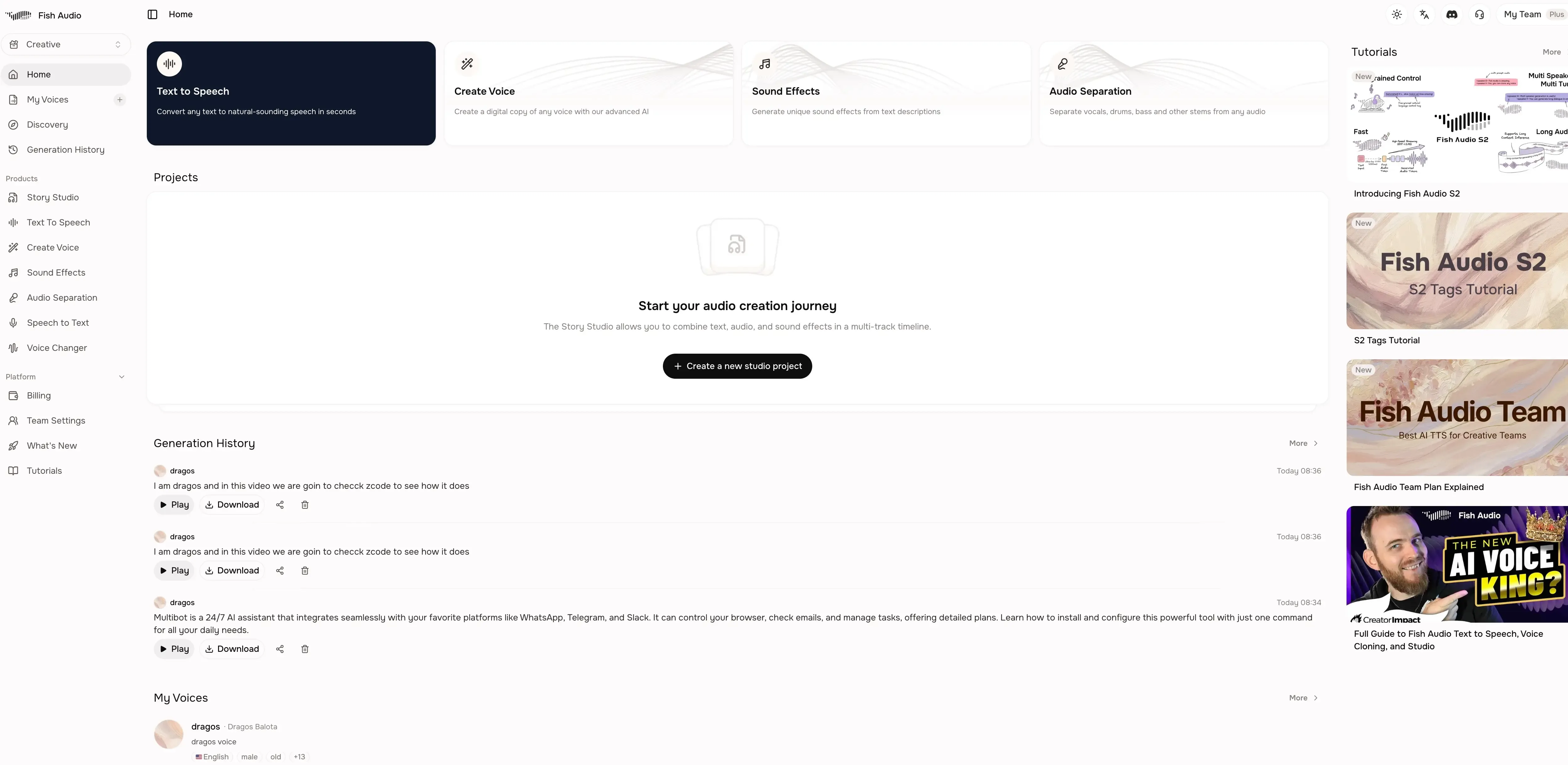
Fish Audio clones faster and with less audio. You need about 10 to 15 seconds of clear speech. Upload it, wait about two minutes, and you have a working clone. The quality is good. I used my own clone for a week of YouTube narration and nobody noticed it was AI.
ElevenLabs has two cloning modes. Instant Voice Cloning needs about 10 seconds of audio but is only available on paid plans starting at $6/month (Starter), and the quality is decent but not great. Professional Voice Cloning needs 30+ minutes of audio and produces near-perfect results, but it is only on the $22/month Creator plan and above.
Here is the practical difference: if you want to clone your voice quickly and cheaply, Fish Audio does it in under two minutes for free. If you want the absolute highest fidelity clone and you are willing to record 30 minutes of audio and pay $22/month, ElevenLabs Professional Voice Cloning is better.
Voice data ownership
ElevenLabs updated their terms of service to claim “perpetual, irrevocable, royalty-free” rights over voice data uploaded to their platform. Fish Audio does not have this clause. If you are cloning your own voice for commercial use, read both platforms’ terms carefully.
Pricing
This is where the gap gets wider.
ElevenLabs pricing
| Plan | Price | Characters/month | Cloning |
|---|---|---|---|
| Free | $0 | 10,000 | No |
| Starter | $6/mo | 30,000 | Instant only |
| Creator | $22/mo | 121,000 | Professional |
| Pro | $99/mo | 600,000 | Professional |
| Scale | $299/mo | 1,800,000 | Professional |
Credits do not roll over. If you do not use them, they disappear. The Creator plan at $22/month is the minimum for Professional Voice Cloning.
Fish Audio pricing
| Plan | Price | What you get |
|---|---|---|
| Free | $0 | Limited generations, community voices, free S2.1 Pro API |
| Starter | ~$15/mo | More generations, voice cloning, priority processing |
| Pro | ~$45/mo | Higher limits, commercial rights |
| Enterprise | Custom | SLA, dedicated support |
Fish Audio uses pay-as-you-go pricing. No credit expiry. The free S2.1 Pro API gives developers the same model quality as the paid tier with no hard usage cap.
For a creator producing about 2 hours of audio per month, the cost comparison works out to roughly:
- ElevenLabs Creator plan: $22/month for 121,000 characters
- Fish Audio Starter plan: ~$15/month with similar or better output
That is about $84/year savings. Over a few years, it adds up.
Get Started with Fish AudioLanguage support
Fish Audio supports 83 languages. ElevenLabs supports 32.
The raw number is not the whole story. What matters is how well each platform handles the languages you actually need. For major languages like English, French, German, Spanish, and Japanese, both are solid. For less common languages, Fish Audio generally has better coverage and more natural pronunciation.
I create content in English and Romanian. Fish Audio handles both well. ElevenLabs Romanian is usable but has noticeable issues with certain vowel sounds and word stress patterns. If you create content in Asian languages, Fish Audio has stronger support for Chinese, Japanese, and Korean.
Emotion and expression
Fish Audio uses a tag system. You insert tags like (excited), (sad), (whisper), or (angry) directly into your text, and the voice changes delivery for that section. It takes some practice to get right, but the results are worth it.
ElevenLabs has “emotional” voices in their library, but you cannot control emotion within a single generation. You pick a voice that sounds a certain way and it stays that way throughout. If your script shifts from serious to upbeat, you need to generate separate clips and stitch them together in post.
For narration work where tone shifts matter, like YouTube videos, audiobooks, or training content, Fish Audio’s tag system is a significant advantage.
API and developer experience
Both platforms have solid APIs. ElevenLabs has been around longer and has more third-party integrations. Their documentation is thorough and the JavaScript/Python SDKs are mature.
Fish Audio’s API is clean and straightforward. The REST endpoints are well-documented, and the Python SDK works as expected. The free S2.1 Pro API is a strong draw for developers testing TTS in their apps. Set model: "s2.1-pro-free" and you are running the same model as paying customers.
One practical difference: Fish Audio’s API pricing at $15/million characters is about half of ElevenLabs’ ~$30/million characters. For high-volume applications, this difference is significant.
Fish Audio has also been closing feature gaps. Speech-to-text is in now: transcribe-1 for general audio and transcribe-1-pro for multi-speaker recordings — it marks speakers inline and keeps cues like [laughter] in the transcript — at $0.36 per audio hour for either model. That answers ElevenLabs’ Scribe. Pronunciation dictionaries are new too (define a name or acronym once, reuse it across every request), matching a feature ElevenLabs has had for a while. And the official MCP server at api.fish.audio/mcp lets an agent search voices, run TTS, transcribe, and generate images or videos — ElevenLabs has an MCP server as well, but Fish’s reaches into the whole creative suite.
Both companies also sell a voice-agent platform now — Fish Agents versus ElevenLabs’ Conversational AI — with web-widget embeds and real phone numbers. ElevenLabs’ is the more mature of the two today.
Who should pick Fish Audio
Multilingual creators. If you produce content in more than one language, Fish Audio handles it better and cheaper.
Budget-conscious creators. The free tier is functional, voice cloning is free, and the paid plans are cheaper than ElevenLabs.
Developers. The free S2.1 Pro API and lower per-character pricing make Fish Audio the better choice for building TTS into products.
Anyone who wants emotion control. The tag system lets you shape delivery within a single generation, which ElevenLabs cannot do.
Who should pick ElevenLabs
English-only creators who want the best quality. ElevenLabs English voices are still the benchmark. If you only produce English content and quality is your top priority, it is worth the extra cost.
Teams that need a polished interface. ElevenLabs has a more refined web app and better third-party integrations.
Enterprise users. ElevenLabs has more enterprise features, including HIPAA compliance and custom SSO.
My recommendation
I switched from ElevenLabs to Fish Audio and I am not going back. The voice quality is close enough for my YouTube content, the multilingual support is better, and I am saving about $84/year. The emotion tags took some getting used to, but now I cannot imagine going back to flat TTS.
If you only produce English content and money is not a concern, ElevenLabs is still the better tool. For everyone else, Fish Audio is the better value.
Try Fish Audio FreeCan I use Fish Audio and ElevenLabs together?
Yes. Some creators use ElevenLabs for their primary English narration voice and Fish Audio for multilingual versions or secondary characters. Both platforms export standard audio files, so mixing them in post-production is straightforward.
Which has better voice cloning?
Fish Audio clones faster (10-15 seconds vs 60+ seconds) and is cheaper (free vs $22/month for professional cloning). ElevenLabs Professional Voice Cloning produces slightly higher fidelity results but requires 30+ minutes of audio. For quick clones, Fish Audio is the better choice. For studio-grade clones, ElevenLabs has an edge.
Is ElevenLabs worth the extra cost?
For English-only content where maximum voice quality matters, yes. For multilingual content, budget-conscious projects, or developers building TTS into apps, no. Fish Audio gives you more for less in those cases.
What about voice data ownership?
ElevenLabs claims perpetual, irrevocable, royalty-free rights over voice data in their terms of service. Fish Audio does not have this clause. If you are cloning your own voice, this difference matters. Read both platforms’ terms before uploading sensitive audio.
Related articles
- Fish Audio review 2026 — full product review, free API, pros and cons
- Clone your voice with Fish Audio — 2-minute walkthrough with screenshots
- Add voice cloning TTS to Mastra with Fish Audio — agent integration with emotion tags and API
- Fish Audio vs MiniMax comparison — if you are also weighing MiniMax Speech
- Text-to-Speech with uv — run TTS locally from the command line
Lee en espanol: Resena Fish Audio | Fish Audio vs ElevenLabs | Clonar Tu Voz | Fish Audio vs MiniMax