Fish Audio vs MiniMax 2026: Which AI Voice Tool Wins?
Side-by-side Fish Audio vs MiniMax on cloning, English vs Chinese quality, pricing, and free API. I ran the same YouTube scripts through both.

Updated Published 20 min read
I clone my voice in Fish Audio from a short clip and use it on YouTube. When MiniMax’s Speech-02 started topping the Artificial Analysis Speech Arena leaderboard, I ran the same scripts through both tools to see if I should switch. Spoiler: I mostly stayed on Fish Audio, but MiniMax wins a few specific cases.
What this covers
- Voice quality and naturalness comparison
- Voice cloning speed and fidelity
- Emotion and expression controls
- Language support and multilingual performance
- Developer API and pricing
- Which platform fits different use cases
The short version
Fish Audio wins on library size, developer pricing, free API tier, and language coverage (83 languages). MiniMax sounds great, especially in Chinese, and its sound tags for laughs and breaths are fun for expressive narration. If you are multilingual or cost-sensitive, start with Fish. If Chinese quality is the whole job, try MiniMax first.
| Feature | Fish Audio | MiniMax |
|---|---|---|
| Latest model | S2.1 Pro | Speech 2.8 (HD/Turbo) |
| Languages | 83 | 40+ |
| Voice cloning audio needed | 10-15 seconds | 10 seconds |
| Community voices | 2 million+ | 300+ |
| Emotion control | Tags like (excited), (whisper) | Tags + sound effects (laughs), (breath) |
| API pricing | $15/million chars | $60-100/million chars |
| Free tier | Yes, with free S2.1 Pro API | Limited free usage |
| Best for | Multilingual, budget-conscious | Chinese content, expressive narration |
Voice quality
Both platforms produce natural-sounding speech. The differences are subtle but real.
Fish Audio’s S2.1 Pro model handles English well. The output sounds clean, the pacing is natural, and the emotion tags let you shift tone within a generation. I use it for YouTube narration and the quality is good enough that most viewers do not notice it is AI.
MiniMax Speech 2.8 HD focuses on high-fidelity narration. According to Artificial Analysis, their Speech-02 model ranks at or near the top of the leaderboard for voice quality. The HD variant produces polished output suitable for audiobooks and professional voiceovers. The Turbo variant trades some quality for speed, which is better for real-time applications.
For Chinese content, MiniMax has an edge. Their models were built with strong Chinese language support from the start, and the pronunciation and rhythm in Mandarin are more natural than most competitors. If you create Chinese content, MiniMax is worth testing first.
For English and other European languages, the difference is less clear. Both produce good results. I would recommend generating the same script on both platforms and comparing the output side by side.
Voice cloning
Both platforms clone voices from short audio samples. The process is similar, but the details differ.
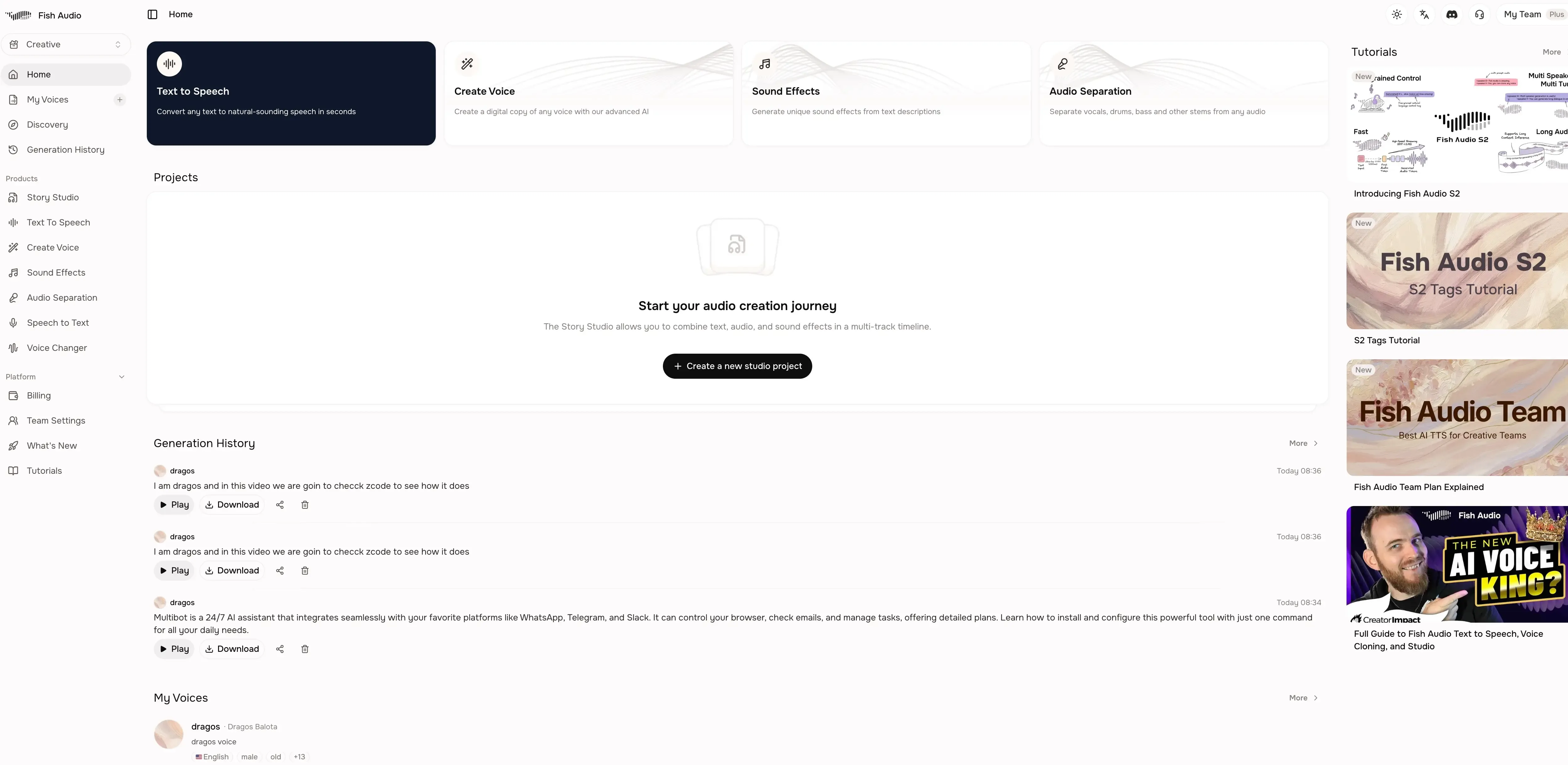
Fish Audio needs 10 to 15 seconds of clear audio. Upload it, wait about two minutes, and the clone is ready. The quality is good for content creation. My clone sounds close enough to my real voice that listeners cannot tell the difference in a YouTube video.
MiniMax needs about 10 seconds of audio. The cloning process takes about 30 seconds. Their Speech 2.5 announcement claims the model can “flawlessly replicate a person’s unique accent, speaking style, and emotional tone” across languages. The cross-lingual cloning preserves vocal characteristics when switching between languages, which is useful for multilingual content.
One practical difference: MiniMax deletes unused cloned voices after 7 days. If you clone a voice and do not use it, you will need to re-clone. Fish Audio keeps your clones as long as your account is active.
Emotion and expression controls
This is where the platforms diverge in interesting ways.
Fish Audio uses emotion tags. You insert tags like (excited), (sad), (whisper), or (angry) into your text, and the voice changes delivery for that section. The system is simple and effective. You can shift tone within a single generation without editing multiple clips together.
MiniMax has emotion tags too, but also supports sound tags and interjection tags. These add non-verbal vocal expressions:
(laughs)— adds laughter(chuckle)— subtle laugh(breath)— audible breathing(sighs)— a sigh(clear-throat)— throat clearing(gasp)— surprised intake of breath
These sound tags make narration feel more human, especially in storytelling or character-driven content. A breath between paragraphs or a chuckle after a casual line changes how the listener experiences the audio.
MiniMax also supports pause markers with <#x#> syntax, where x is the pause duration in seconds. This gives you precise control over pacing without relying on punctuation tricks.
If you need basic emotion control, both platforms work. If you need granular control over non-verbal sounds and pauses, MiniMax has more options.
Language support
Fish Audio supports 83 languages. MiniMax supports 40+.
The raw numbers favor Fish Audio, but what matters is how well each platform handles the languages you actually need. Here is what I found:
For English: Both are solid. Fish Audio and MiniMax produce clean, natural English output.
For Chinese: MiniMax is stronger. Their models were optimized for Chinese from the beginning, and the Mandarin output sounds more natural.
For European languages: Both handle major languages well (French, German, Spanish, Portuguese, Italian). Fish Audio has better coverage for less common European languages.
For Asian languages: MiniMax has strong support for Japanese, Korean, and Vietnamese. Fish Audio covers these too, but MiniMax’s Asian language support is more polished.
If you create content in one or two major languages, both platforms work. If you need wide language coverage across many different languages, Fish Audio has the advantage.
Developer API
Both platforms offer REST APIs, though Fish Audio’s has grown past text-to-speech. The developer experience differs in a few ways.
Fish Audio API
- REST endpoints and Python SDK
- Free S2.1 Pro API (set
model: "s2.1-pro-free") - Pricing: $15/million characters
- Speech-to-text too:
transcribe-1andtranscribe-1-pro(multi-speaker markers, emotion cues), $0.36/audio hour - Pronunciation dictionaries via web app or API
- MCP server covering TTS, transcription, and image/video generation
- Documentation at docs.fish.audio
- Supports streaming and batch generation
MiniMax API
- REST API at
/v1/t2a_v2 - Two model variants:
speech-2.8-hdandspeech-2.8-turbo - Pricing: $60/million chars (Turbo), $100/million chars (HD)
- Available through MiniMax directly or third-party providers (Replicate, fal.ai)
- Supports streaming, subtitle timestamps, and async long-form workflows
The pricing difference is significant. Fish Audio at $15/million characters is about 4x cheaper than MiniMax Turbo at $60/million characters, and about 7x cheaper than MiniMax HD at $100/million characters.
For developers building TTS into products, Fish Audio’s free S2.1 Pro API is hard to beat. You get the same model quality as paying customers with no hard usage cap. MiniMax does not have an equivalent free tier for their best models.
One more gap worth noting: MiniMax’s public audio API is TTS-focused, with no self-serve speech-to-text endpoint as of this writing. Fish Audio now covers both directions — transcribe-1 for plain transcription and transcribe-1-pro for multi-speaker meetings with inline speaker markers — plus pronunciation dictionaries and an MCP server that reaches the image and video tools. If your product needs STT alongside TTS, MiniMax does not offer it.
Developer tip
If you are building a product that needs TTS, start with Fish Audio’s free S2.1 Pro API. Set model: "s2.1-pro-free" in your API call. Same quality as the paid tier, no cost.
Pricing comparison
| Fish Audio | MiniMax | |
|---|---|---|
| Free tier | Yes, with S2.1 Pro free API | Limited |
| Paid plans | From ~$15/mo | Pay-as-you-go |
| API pricing | $15/million chars | $60-100/million chars |
| Voice cloning cost | Free | $3 per voice (via Replicate) |
| Credit expiry | None | Varies by provider |
Fish Audio is cheaper at every level. The free tier is more generous, the paid plans cost less, and the API pricing is significantly lower. For high-volume applications, the cost difference adds up fast.
MiniMax’s pricing through third-party providers like Replicate may differ from their direct pricing. Check the specific provider’s rates before committing.
Get Started with Fish AudioVoice library
Fish Audio has over 2 million community-uploaded voices. MiniMax has about 300 official voices.
The size difference matters when you are looking for a specific voice style. With 2 million voices, you can search by language, accent, age, gender, and use case. Finding something close to what you need without cloning is realistic on Fish Audio.
MiniMax’s 300 voices are curated and generally high quality. You are less likely to find a mediocre voice in their library. But the selection is smaller, so you might not find the exact style you want.
If you prefer to browse and pick from a large selection, Fish Audio wins. If you prefer a smaller, curated set of reliable voices, MiniMax works.
Who should pick Fish Audio
Budget-conscious creators. The free tier and low API pricing make Fish Audio the cheaper option at every usage level.
Multilingual creators. 83 languages vs 40+ means better coverage for less common languages.
Developers. The free S2.1 Pro API and lower per-character pricing make Fish Audio the better choice for building TTS into products.
Anyone who wants a large voice library. Two million voices means you will probably find what you need without cloning.
Who should pick MiniMax
Chinese content creators. MiniMax’s Chinese language support is the best I have heard.
Creators who need sound tags. The ability to add laughs, breaths, sighs, and other non-verbal sounds makes narration feel more human.
Teams already in the MiniMax ecosystem. If you use MiniMax’s other AI products (video, music), staying in the same ecosystem simplifies things.
Users who need precise pause control. The <#x#> syntax gives you exact control over pacing.
My take
I use Fish Audio and I am staying with it. The pricing is better, the language coverage is wider, and the free API is useful for my side projects. MiniMax is a strong platform, especially for Chinese content and expressive narration, but the 4-7x price difference on API usage is hard to justify for my use case.
If I were creating Chinese content or needed the sound tag system for character-driven narration, I would seriously consider MiniMax. For everything else, Fish Audio is the better value.
Is MiniMax Speech-02 better than Fish Audio S2.1 Pro?
It depends on the use case. MiniMax Speech-02 ranks highly on voice quality benchmarks and has strong Chinese language support. Fish Audio S2.1 Pro has wider language coverage, lower pricing, and a free API tier. For most users, the difference in English voice quality is small enough that pricing and language support matter more.
Can I use both platforms together?
Yes. Both export standard audio files (MP3, WAV). You can generate different sections of a project on different platforms and combine them in your editor. Some creators use MiniMax for Chinese narration and Fish Audio for English.
Which has better voice cloning?
Both clone from about 10-15 seconds of audio with similar quality. MiniMax claims better cross-lingual cloning (preserving your voice across languages). Fish Audio keeps clones permanently while MiniMax deletes unused clones after 7 days. Test both with your own voice to see which sounds better to you.
Is MiniMax free?
MiniMax has limited free usage. Their best models (Speech 2.8 HD) cost $100/million characters. Through third-party providers like Replicate, you may get small free tiers. Fish Audio’s free S2.1 Pro API is more generous for developers.
Related articles
- Fish Audio review 2026 — full product review, pricing, free API tier
- Fish Audio vs ElevenLabs — the comparison most people want first
- Clone your voice with Fish Audio — 2-minute walkthrough with screenshots
- Add voice cloning TTS to Mastra with Fish Audio — wire Fish Audio into Mastra agents for narration
- Text-to-Speech with uv — run TTS locally from the command line
Lee en espanol: Resena Fish Audio | Fish Audio vs ElevenLabs | Clonar Tu Voz | Fish Audio vs MiniMax