
16GB Raspberry Pi 5 at $385 vs Mini PCs: Why the Homelab Math Flipped
The 16GB Raspberry Pi 5 now costs $385, over 3x launch. Full total-cost math vs N150 mini PCs, used ThinkCentre boxes, and Orange Pi, plus what the Pi still wins.
7 min read
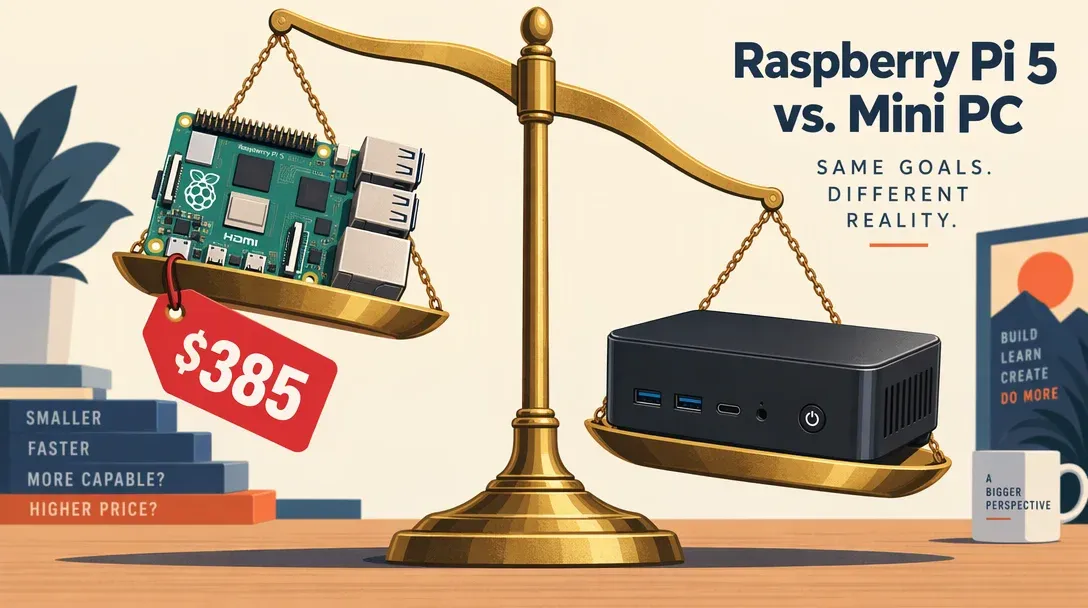
On November 3, 2026, Raspberry Pi raised the price of the 16GB Pi 5 by another $80 to $385, more than triple the $120 launch price from January 2025 for the exact same hardware. The 16GB Compute Module 5 went up $40 alongside it. Tight DRAM supply driven by AI datacenter demand is squeezing single-board computers just as hard as server memory.
At $120, buying a Pi for containers was an easy habit. At $385 for a bare board, the total bill flips the decision completely, so it is worth putting the full parts list next to what x86 mini PCs cost right now.
Affiliate Disclosure
Some links in this guide are affiliate links. If you buy through them, we may earn a small commission at no extra cost to you. This helps us keep testing and updating these recommendations.
The honest total: a Pi 5 is never just the board
The $385 headline is for the bare board. A Pi that actually does server work needs the rest of the costume:
| Line item | Realistic price (Nov 2026) |
|---|---|
| Raspberry Pi 5 16GB board | $385 |
| Official 27W USB-C PSU | ~$12 |
| Case + active cooler | ~$15–25 |
| NVMe HAT (SD card is not a server disk) | ~$15–30 |
| 500GB NVMe SSD | ~$45 |
| Working total | ~$475–500 |
Call it $475 for a 16GB ARM box with 1GbE, no hardware video encoder, and storage hanging off a PCIe HAT. Now hold that number against the alternatives.
What the same money buys in x86
| Option | Street / Amazon price | CPU | RAM/Storage | Networking |
|---|---|---|---|---|
| Pi 5 16GB full build | ~$475–500 | BCM2712, 4C/4T ARM | 16GB / 500GB (HAT) | 1x 1GbE |
| Beelink Mini S13 (N150) | ~$210–349 | Intel N150, 4C/4T | 16GB / 500GB NVMe (2x M.2) | 1x 1GbE/2.5GbE (varies by SKU) |
| Beelink EQ14 (N150) | ~$200–369 | Intel N150, 4C/4T | 16GB / 500GB NVMe (2x M.2) | Dual 2.5GbE |
| GMKtec M6 Ultra | ~$430–630 | Ryzen 5 7640HS, 6C/12T | 32GB / 1TB NVMe (2x M.2) | Dual 2.5GbE, USB4 |
| Used ThinkCentre/EliteDesk 1L | ~$100–180 | i5-8500T, 6C/6T | 8–16GB / 256GB+ | 1x 1GbE |
Compare the first three rows directly. Mini PC retail pricing swings with 2026 memory costs (promos around $200–250 vs. current Amazon prebuilt listings near $349 for the S13 and $369 for the EQ14), yet even at full retail an N150 box saves $100 to $275 over the assembled 16GB Pi 5. For less money, you get the same 16GB/500GB starting capacity, two built-in M.2 slots instead of a PCIe HAT, Intel Quick Sync for Plex or Jellyfin transcoding, and standard x86 compatibility with every Docker image and Debian package.

Beelink Mini S13 (Intel N150, 16GB/500GB)
Compact N150 mini PC with 16GB RAM, a 500GB SSD, dual M.2 slots, and single-digit idle wattage for less than an assembled 16GB Pi 5.
Price & availability at Amazon.com How I test
Key Features
- Intel N150, 4C/4T up to 3.6GHz with Quick Sync
- 16GB DDR4 + 500GB M.2 SSD (dual M.2 2280 slots)
- Single Ethernet (1GbE or 2.5GbE depending on listing) + Wi-Fi 6
- ~6-9W idle power draw
What we like
- Costs ~$125–$265 less than a kitted 16GB Pi 5 depending on current sales
- Standard x86 avoids arm64 image misses
- Dual M.2 slots included without add-on HATs
Watch out for
- No GPIO header or camera ribbon ports
- External power brick instead of built-in PSU
Important Considerations
- •Check listing details for 1GbE vs 2.5GbE LAN; step up to the EQ14 if you need dual 2.5GbE
- •Uses DDR4 rather than DDR5, which is fine for container hosts
Disclosure: This post contains affiliate links. We may earn a commission if you purchase through these links at no additional cost to you.
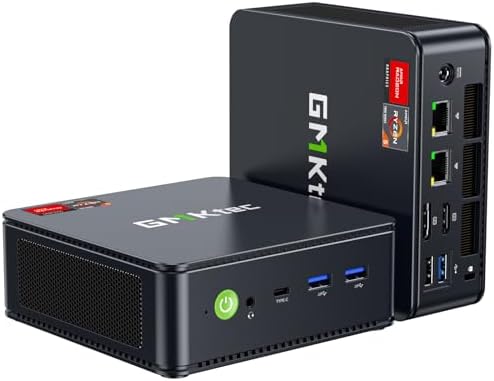
GMKtec M6 Ultra (Ryzen 5 7640HS, 32GB/1TB)
6-core/12-thread Zen 4 mini PC with 32GB DDR5, 1TB NVMe, dual 2.5GbE, and USB4. Proper headroom if you want Proxmox VMs.
Price & availability at Amazon.com How I test
Key Features
- Ryzen 5 7640HS: 6C/12T Zen 4, up to 5.0GHz
- 32GB DDR5 + 1TB NVMe (dual M.2 2280 PCIe 4.0 slots)
- Dual 2.5GbE + USB4 for fast external storage
- Radeon 760M iGPU
What we like
- 32GB DDR5 and 1TB NVMe near the cost of an assembled 16GB Pi
- Real headroom for Proxmox clusters and heavy Docker stacks
- Dual M.2 PCIe 4.0 slots + USB4 expansion
Watch out for
- Overkill for lightweight DNS and container stacks
- Higher fan noise under sustained CPU load than an N150
Important Considerations
- •Idle power sits closer to ~8-12W and fans spin up under VM load
- •Retail pricing sits around $430 on sale to ~$630 list for 32GB/1TB
Disclosure: This post contains affiliate links. We may earn a commission if you purchase through these links at no additional cost to you.
The fifth row deserves its own callout. Used 1-liter business desktops (Lenovo ThinkCentre Tiny, Dell OptiPlex Micro, HP EliteDesk Mini) offer the best hardware value of this whole price cycle. An 8th-gen Core i5-8500T box with 16GB RAM and a 256GB NVMe regularly sells for $100 to $180 on eBay or Amazon Renewed, idles around 7 to 10W, and runs Proxmox, TrueNAS SCALE, or plain Debian smoothly.
What the Pi still wins (and it’s a real list)
None of this makes the Raspberry Pi obsolete, because its core hardware strengths never relied on having 16GB of RAM:
- GPIO and HATs. Sensors, relays, displays, CAN buses, and PoE HATs form a physical electronics ecosystem x86 mini PCs simply lack.
- Native camera and display connectors. Built-in CSI and DSI ports still beat fighting USB capture cards for robotics and kiosk builds.
- Power and footprint. A 3 to 4W idle draw on a credit-card board stays practical inside portable enclosures and battery projects.
- Documentation depth. Nearly every obscure kernel flag or pinout quirk has years of forum answers behind it.
- Microcontrollers. Smaller sensor duties long ago moved to $5–15 Pico and ESP32 boards, which remains the smarter split.
What disappeared from that list is using a maxed-out Pi as a general-purpose Docker server. Even power efficiency no longer rescues the budget: a Pi 5 idling around 3W versus an N150 around 7W saves roughly $7 to $10 a year at $0.20/kWh. At a $125 to $265 upfront gap, the mini PC comes out ahead for years.
The 4GB and 8GB models are a different question
This comparison applies specifically to the 16GB Pi 5 at $385. If 4GB or 8GB covers your container load at lower pricing, the gap narrows, though an N150 mini PC still keeps the edge on included NVMe storage, Quick Sync, and x86 software support. Keep cheaper Pis for GPIO projects.
So what should a homelabber buy?
- GPIO, CSI cameras, HATs, embedded builds -> Pi 5 8GB, or a Pico/ESP32 where full Linux isn’t needed
- Always-on Docker, Home Assistant, Jellyfin -> Beelink Mini S13 or EQ14 (N150), ~$200–$369 depending on sales and SKU
- Proxmox labs and multiple VMs -> GMKtec M6 Ultra (32GB DDR5), or a pair of used 1L corporate boxes
- Tightest budget -> used ThinkCentre/OptiPlex/EliteDesk 1L (i5-8500T), ~$100–180
- Already own a Pi 5 -> keep running it; paid hardware doesn’t get slower when MSRP rises
For Home Assistant specifically, our Home Assistant hardware guide compares Home Assistant Green, mini PCs, and Pis side by side. For media servers, best mini PC for Plex and Jellyfin breaks down Quick Sync stream limits, and if renting cloud compute is the alternative on your mind, our VPS price increases breakdown shows why used 1L boxes are taking over that niche too.
FAQ
Will Pi prices come back down?
Raspberry Pi described the increase as temporary driven by AI datacenter DRAM demand, without giving a return date. Memory shortages push up mini PC SODIMM prices too, which is why retail listings have climbed past $300 on some N150 boxes, so buying based on today’s street prices makes more sense than waiting on a rollback.
Is ARM vs x86 still a real compatibility issue for servers?
Most mainstream Docker containers ship arm64 images now, though odd edge cases remain: older vendor binaries, proprietary monitoring agents, or niche containers built only for amd64. On x86 you never have to check the tag architecture first.
What about the Orange Pi 5 and other ARM SBCs?
The Orange Pi 5 Plus (RK3588, 8 cores, 16GB, dual 2.5GbE, M.2) around $150–200 undercuts the $385 Pi 5 by more than half with faster I/O. The compromise is software polish: Raspberry Pi OS kernel support and docs remain easier to live with unless you are already comfortable maintaining Armbian installs.
Does a mini PC idle as low as a Pi?
Close enough for utility bills not to decide it. A Pi 5 idles near 3–4W compared to 6–9W for an N150 box, roughly $7–10 difference per year at $0.20/kWh. Power savings only favored the Pi when the board cost $60 to $120.
I just bought a 16GB Pi 5 before the hike. Keep it?
Definitely. The hardware hasn’t changed, and at $120–300 you paid a fairer price than anyone buying today. Use what you already own until you actually hit a limit.
Verdict
At $385 bare (roughly $475 to $500 once you add a power supply, case, cooler, NVMe HAT, and SSD), the 16GB Raspberry Pi 5 makes sense mainly if your build requires GPIO, CSI/DSI connectors, or that exact footprint alongside 16GB of memory. For running Docker containers, Home Assistant, or a media server, an N150 box like the Beelink Mini S13 or EQ14 (or a $150 used ThinkCentre Tiny) gives you x86 compatibility, Quick Sync, and dual M.2 slots for significantly less money.
Best mini PCs for home serversRelated articles
- Best mini PCs for a home server (full ranked shortlist)
- Best Home Assistant hardware (Green vs mini PC vs Pi)
- Best mini PC for Plex & Jellyfin (Quick Sync transcode picks)
- VPS price increases: when a mini PC wins (cloud vs local hardware math)
- ARM vs x86 VPS benchmarks (real-world architecture comparison)
Related Posts
Did this guide work for you?

Written by Dragos
Dragos is the author of Bitdoze — practical DevOps, programming, and self-hosting guides.
More guides from Dragos →Need help with Astro, VPS, or a self-hosted app? View services →